
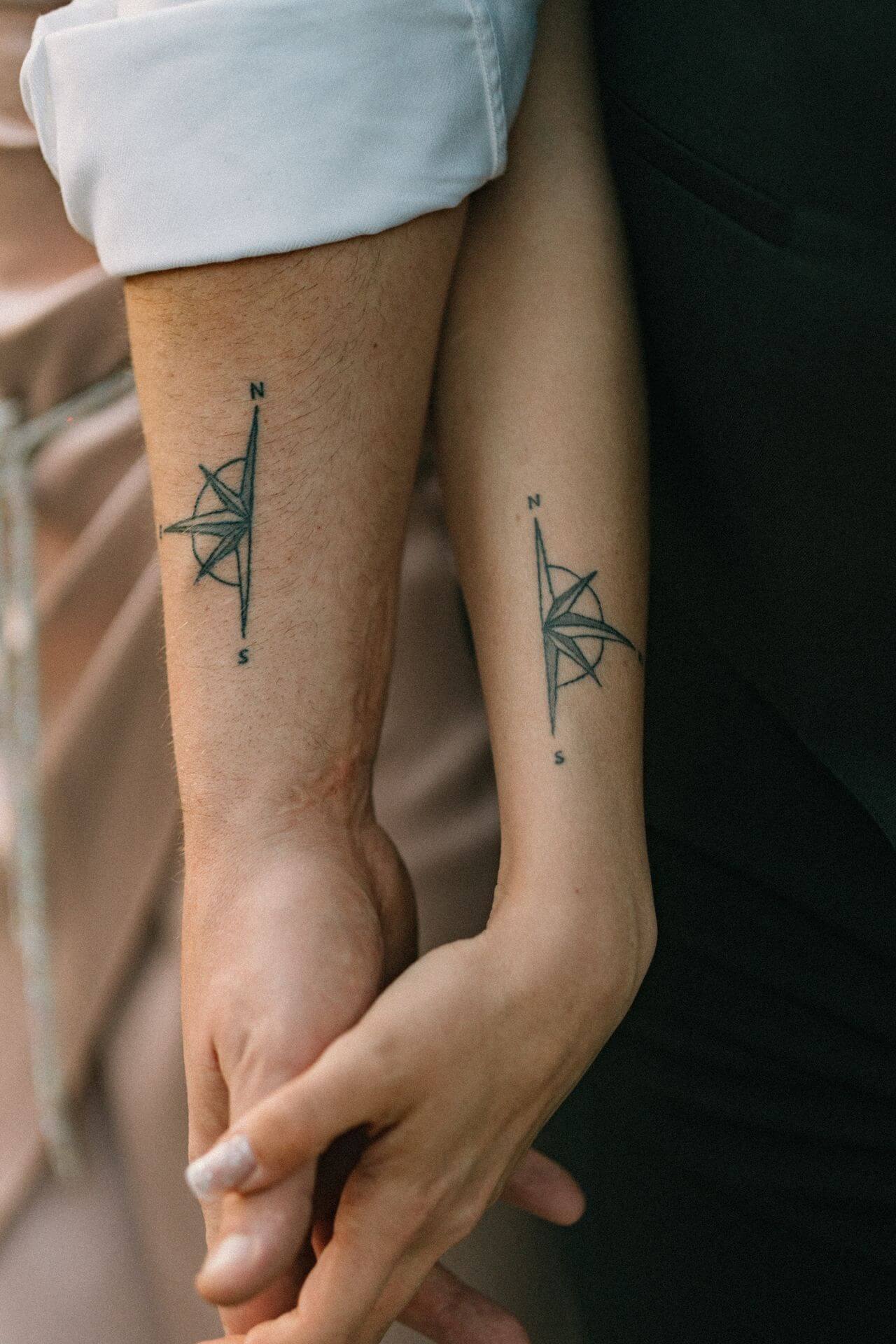
Matching tattoos do not have to be exact copies.
Friends, siblings, parents, children, and other family members can share one concept while choosing different images, placements, colors, or artistic styles. The connection can be obvious when the tattoos are placed together or remain hidden within a small repeated detail.
This approach gives each person more freedom while preserving the reason they decided to get tattooed together.
Key Takeaways
- Matching tattoos can share a theme without using identical designs.
- Complementary symbols work well for two people who want different imagery.
- Groups can use one repeated detail across several individual tattoos.
- Placement does not need to match for the tattoos to feel connected.
- Personal memories usually create stronger designs than generic friendship symbols.
- Friends and relatives can use different tattoo styles while keeping one shared concept.
- Everyone should choose the tattoo voluntarily rather than feeling pressured by the group.
Matching Does Not Have to Mean Identical
Traditional matching tattoos often use the same symbol in the same size and placement.
That approach can work, but it is only one option.
Two people may want completely different tattoos while still representing the same relationship.
One friend may choose the sun while another gets the moon. Siblings might choose different flowers from the same botanical family.
A parent and adult child could use a tree and branch rather than repeating one image.
The relationship between the designs becomes the matching element.
This often produces tattoos that feel more personal because each person can choose an image that fits their identity.
Complementary Tattoo Ideas for Two People
Complementary tattoos use separate images that create one concept when understood together.
Some combinations rely on visual opposites, while others represent two parts of the same story.
A lighthouse and ship can represent guidance and journey. A mountain and river may represent two connected parts of a meaningful landscape.
A flower and bee can create a botanical relationship without requiring matching floral tattoos.
Other combinations might use a book and bookmark, lock and key, bow and arrow, sun and moon, or two parts of a constellation.
The best combination should have personal relevance rather than being selected only because the two images are commonly paired.
Tattoos That Complete One Image
Some matching tattoos create a larger design when two people place them beside each other.
A line may continue from one arm to another. Two sections of a landscape can form a complete scene.
A circle, heart, flower, or geometric form may be divided between two people.
This concept can be visually striking, but each half should still look intentional on its own.
Friends and relatives will not spend most of their lives standing beside each other with the tattoos aligned.
The individual designs therefore need enough structure to function independently.
Shared Symbols With Different Treatments
Using the same subject does not require using the same design.
Two people might both choose ravens while selecting different poses.
Three siblings may each tattoo the same flower but use fine line, traditional, and engraving-inspired styles.
A family may choose one animal associated with their home while every member interprets it differently.
The repeated subject creates the connection.
Different visual treatments allow each tattoo to fit the wearer’s existing collection and personal taste.
| Shared Concept | Individual Variation |
| Same flower | Different growth stages |
| Same animal | Different poses |
| Same landscape | Different sections |
| Same celestial theme | Sun, moon, and stars |
| Same object | Different angles or versions |
| Same symbol | Different tattoo styles |
This is especially useful when participants work with different artists.
Matching Tattoos Based on a Shared Memory
A shared memory can provide more original tattoo inspiration than a standard friendship symbol.
Think about trips, childhood experiences, concerts, hobbies, family traditions, school memories, or ordinary moments that became important over time.
Two friends who met while traveling might choose different symbols from that destination.
Siblings could use objects from a childhood game or television show they watched together.
Family members might choose different elements from a home where everyone grew up.
The design does not need to communicate the complete story to strangers.
Its value comes from the people wearing it recognizing the connection immediately.
Matching Tattoos for Best Friends
Friendship tattoos can represent the relationship without using names or conventional friendship imagery.
Inside jokes can become small objects, symbols, animals, or abstract marks.
Friends who regularly hike together might choose separate mountain and trail designs.
People connected through music could choose different instruments, visual references to an album, or another symbol linked to the experience without copying song lyrics.
Food, games, movies, places, hobbies, and shared routines can all become tattoo material.
Humorous tattoos can work particularly well between friends because the design reflects the actual personality of the relationship rather than trying to make it appear overly serious.
Matching Tattoos for Siblings
Sibling tattoos often benefit from a structure that recognizes birth order or individual roles.
Numbers, dots, stars, lines, or symbols can indicate each sibling’s position in the family.
Three siblings might use the same base design with one, two, and three small marks.
Another option is to divide one theme among the group.
One sibling may choose the sun, another the moon, and another a star. Each tattoo functions separately while remaining part of the same celestial system.
Objects from childhood can provide even stronger concepts.
A toy, family tradition, local landmark, favorite meal, or phrase repeatedly used at home may produce a design that belongs specifically to the siblings.
Parent and Adult Child Matching Tattoos
Parent-child matching tattoos can represent both connection and independence.
A parent may choose a complete tree while the child wears a leaf or branch.
A larger bird and smaller bird can create a direct relationship, but more abstract concepts may feel less literal.
Handwriting is another option.
A parent can tattoo a short word written by the child, while the adult child uses handwriting from the parent.
The exchange creates two different tattoos with the same personal source.
The design should respect the adult preferences of both people rather than assuming the child should simply copy the parent’s style.
Matching Tattoos for Larger Family Groups
Group tattoos require additional planning because one design must work across several people.
Exact duplicates may become difficult when participants want different sizes, placements, or tattoo styles.
A modular system often works better.
Each person can use one flower, star, leaf, animal, shape, or object from a broader theme.
A family of five might use five different native flowers connected to the same region.
Another group could choose individual symbols from a family tradition while repeating one small element in every design.
This creates consistency without making everyone wear the same tattoo.
Use One Repeated Detail
One of the most subtle approaches is to repeat a single detail inside otherwise unrelated tattoos.
The connecting element could be a small star, circle, leaf, number, line, color accent, or symbol.
One friend might have a snake tattoo while another chooses a floral piece. The same tiny star could appear inside both compositions.
Family members could have completely different subjects while repeating one small flower connected to a parent or grandparent.
The matching element does not need to be obvious to anyone else.
This works particularly well when each person already has a distinct tattoo style.
Make Sure Everyone Actually Wants the Tattoo
Group excitement can create pressure.
One person may agree because everyone else has already booked the appointment.
A matching tattoo should not become a test of friendship, loyalty, or family commitment.
Each person should choose the design, placement, size, and timing voluntarily.
Someone who does not want a tattoo can still participate in the relationship without permanently marking their body.
The tattoo has more meaning when everyone involved actively chooses it.
Frequently Asked Questions
Can matching tattoos be done by different artists?
Yes. Sharing the agreed symbol, reference, proportions, and important visual details can help separate artists maintain the intended connection.
Can one matching tattoo be larger than the other?
Yes. The designs can use different scales as long as the important shared elements remain recognizable.
Can a new person be added to a group tattoo later?
Sometimes. Modular concepts using flowers, stars, leaves, symbols, or individual objects make future additions easier.
Do matching tattoos need to be done on the same day?
No. Scheduling, travel, artist availability, and personal readiness may make separate appointments more practical.
Create a Connection Without Losing Individuality
Matching tattoos work best when they represent a relationship without erasing the people inside it.
Friends and family can share symbols, memories, colors, themes, or small repeated details while choosing different designs and placements.
Exact copies are only one option.
A complementary pair or group of individually designed tattoos can create a stronger connection because each piece belongs naturally to the person wearing it.
Start with what connects you. Then allow each tattoo to express that connection in its own way.