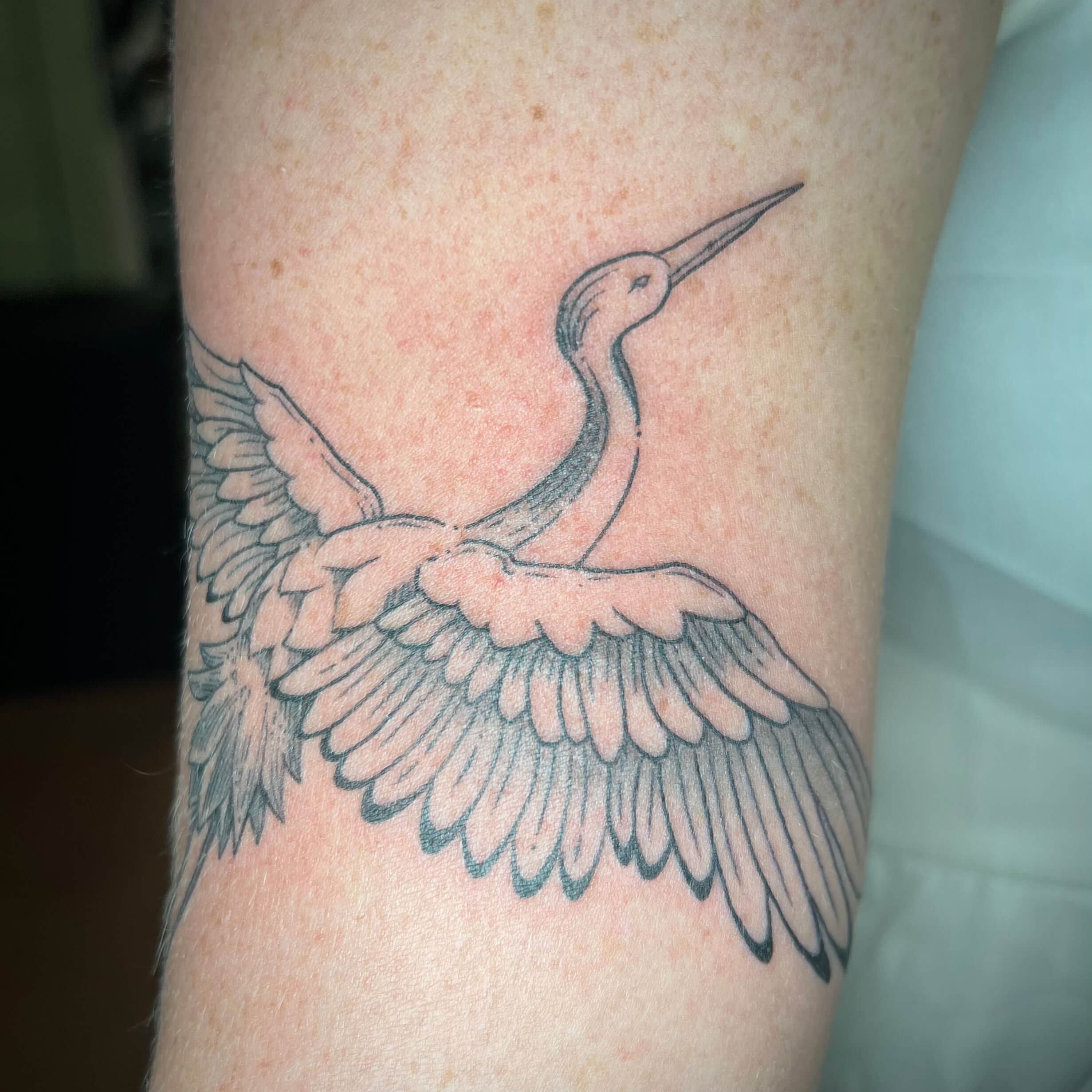
Searching for a fine line tattoo artist near you may return artists who specialize in delicate florals, script, minimalist symbols, and small outline tattoos. Those skills do not automatically qualify someone to create etched or engraving-style work.
An engraving specialist must understand how contour lines, cross-hatching, stippling, solid black, and negative space work together. The artist also needs to simplify historical references and adjust detailed compositions for the size and shape of the body.
Key Takeaways
- Search for engraving, etched, woodcut, illustrative blackwork, and medieval tattoo specialists, not only fine line artists.
- Review healed tattoos before judging line quality or longevity.
- Look for controlled hatching, clear silhouettes, durable negative space, and even black saturation.
- Check whether the artist can draw anatomy, architecture, animals, and symmetrical forms accurately.
- Evaluate complete compositions, not only close-up photographs of individual lines.
- Ask how the design will be simplified for your preferred size and placement.
- Consider traveling beyond your immediate area when the local options do not show relevant specialization.
Fine Line Tattoo Artist vs Engraving Specialist
A general fine line artist usually focuses on narrow outlines and restrained shading. Their portfolio may include small flowers, names, symbols, geometric forms, and delicate portraits.
An engraving specialist uses lines as a complete image-building system. The artist must create form through hatching direction, line density, tonal contrast, and carefully preserved open skin.
The difference becomes more important as the design grows more complex. A small botanical outline may only need clean contours, while a medieval figure or anatomical study requires controlled internal shading and a clear value structure.
| Portfolio Feature | General Fine Line Artist | Etching and Engraving Specialist |
| Primary focus | Delicate outlines | Print-inspired line construction |
| Common shading | Minimal or smooth | Hatching, cross-hatching, and stippling |
| Use of black | Usually limited | Selective structural blackwork |
| Typical subjects | Florals, script, symbols | Anatomy, medieval art, animals, architecture |
| Main technical concern | Clean thin lines | Spacing, tonal groups, and readability |
| Reference process | Simplified illustration | Historical artwork adapted for skin |
Search Using More Specific Terms
Searching only for “fine line tattoo artist near me” may produce results that are too broad.
Try local searches that include engraving tattoo artist, etched tattoo artist, woodcut tattoo artist, illustrative blackwork artist, medieval tattoo artist, or historical tattoo specialist.
The artist may not use the same terminology you use. Some engraving-style tattooers describe their work as dark illustrative, black and grey illustration, medieval blackwork, or print-inspired tattooing.
Search results should lead to the artist’s current portfolio, studio page, or professional social profile. Directory listings can help identify nearby studios, but the final decision should be based on recent and healed work.
Look Beyond the First Search Results
The nearest artist is not always the most suitable artist.
Local search results may favor large studios, heavily reviewed businesses, or artists with strong websites. A specialist with a smaller practice may appear lower in the results despite having a more relevant portfolio.
Review artists in nearby cities and regions when the immediate area does not provide a clear match. Traveling for a specialist may be worthwhile when the tattoo requires detailed architecture, complex cross-hatching, or a large historical composition.
Distance should still be considered realistically. Large projects may require several sessions, so travel expenses, accommodation, and appointment schedules can affect the total commitment.
Review Healed Tattoos
Fresh tattoos often appear darker, sharper, and more precise because the ink and surrounding skin have not fully settled.
Healed photographs reveal whether the fine lines remain separated, whether black areas healed evenly, and whether negative space still protects important details.
Look for tattoos photographed after the initial healing period rather than only immediately after the session. Images should be clear enough to show hatching, contours, and small skin breaks without heavy filters.
A portfolio with no healed examples does not prove that the artist’s work ages poorly. It does give you less evidence for judging how the artist’s line spacing and tonal decisions perform over time.
Evaluate Hatching Quality
Cross-hatching should create shape and shadow rather than appear like a decorative grid.
Lines around a skull, face, flower, or animal should follow the form. Architectural subjects may use straighter marks, while fabric, anatomy, fur, and petals need directional changes.
Check whether lighter areas use wider spacing and darker areas use controlled density. If every part of the design contains the same amount of hatching, the image may lack depth and hierarchy.
The darkest areas should still have a clear purpose. Dense lines and solid black should reinforce the focal point rather than consume important features.
Check Silhouette and Distance Readability
A detailed tattoo should remain recognizable before you examine its smallest marks.
View full photographs rather than relying entirely on close-up images. The main figure, animal, plant, or object should be understandable at a normal viewing distance.
A strong silhouette protects the tattoo if some of the finest details soften over time. It also separates the central subject from borders, architecture, foliage, clouds, or other supporting elements.
Background texture should not carry the same visual weight as the focal point. The artist should know when to reduce detail so the composition does not become uniformly busy.
Inspect Negative Space and Black Saturation
Negative space is the open skin between hatching, contours, dots, and black areas.
Look for visible separation between feathers, leaves, scales, fingers, fabric folds, and overlapping objects. Extremely narrow gaps may be impressive when fresh but can become less distinct after healing.
Solid black should appear consistent and intentional. Patchy saturation or irregular edges may weaken the deepest values and make fine surrounding details harder to read.
The balance between black and open skin matters more than the amount of either one. A good portfolio should show designs with clear highlights, middle values, and deep shadows.
Review Anatomy, Animals, and Architecture
Etching and engraving tattoos often include subjects that expose drawing weaknesses.
Hands, faces, skulls, animal joints, wings, and skeletal structures should look convincing before texture is added. Hatching cannot correct inaccurate anatomy.
Architecture presents different challenges. Towers, arches, windows, circles, and borders require controlled perspective and careful placement on curved skin.
Symmetrical tattoos should appear balanced when worn naturally. An artist who works well on paper must also understand how the stencil changes across shoulders, arms, ribs, thighs, and the chest.
Confirm the Artist Can Adapt References
Historical prints were created for paper and may contain far more detail than the chosen tattoo size can support.
Ask how the artist would simplify the background, widen line spacing, enlarge facial features, or adjust a frame for your placement. The explanation should be specific to the design rather than a vague promise that everything will fit.
A responsible artist may recommend making the tattoo larger or removing secondary elements. This is usually a sign that the artist is protecting readability rather than limiting creativity.
The artist should also create an original adaptation. Using a historical reference is different from copying another tattooer’s completed composition.
Compare Artist Portfolios
| What to Review | Positive Sign | Warning Sign |
| Healed work | Clear lines and stable spacing | Only fresh close-ups |
| Hatching | Follows form and lighting | Same pattern on every surface |
| Silhouette | Subject reads from a distance | Details hide the main shape |
| Negative space | Clear open separation | Crowded lines and narrow gaps |
| Black saturation | Even and deliberate | Patchy or overpowering black |
| Anatomy | Convincing structure | Texture hiding drawing problems |
| Placement | Design follows the body | Flat composition wrapped awkwardly |
| References | Original adaptation | Direct copies of other tattoos |
One weak tattoo does not define an artist’s entire portfolio. Look for consistent quality across several relevant pieces.
Frequently Asked Questions
Should I choose an independent artist or a large tattoo studio?
Either can be suitable. The decision should depend on the individual artist’s portfolio, professionalism, availability, and experience with the style rather than the size of the studio.
Can I ask an artist to show unposted healed work?
Yes. Some artists may have healed photographs or client-submitted images that are not included in their public portfolio.
Is a long waiting list proof that an artist is better?
No. A long waiting list may indicate demand, limited scheduling, or a small practice, but it does not replace portfolio and consultation evaluation.
Should I contact several artists about the same tattoo concept?
You may compare suitable artists before paying a deposit. Avoid asking several artists to create unpaid custom drawings for the same project.
Choose Proven Specialization Over the Nearest Option
Finding a fine line tattoo artist nearby is only the beginning when the design requires etched or engraving-style execution.
The right artist should show healed linework, controlled hatching, strong silhouettes, durable negative space, and accurate drawing. They should also know how to simplify historical references and reshape them for the body.
Search beyond the fine line label and evaluate complete portfolios carefully. A specialist who understands the visual and technical demands of engraving-style tattooing is more valuable than choosing an artist based only on distance.