
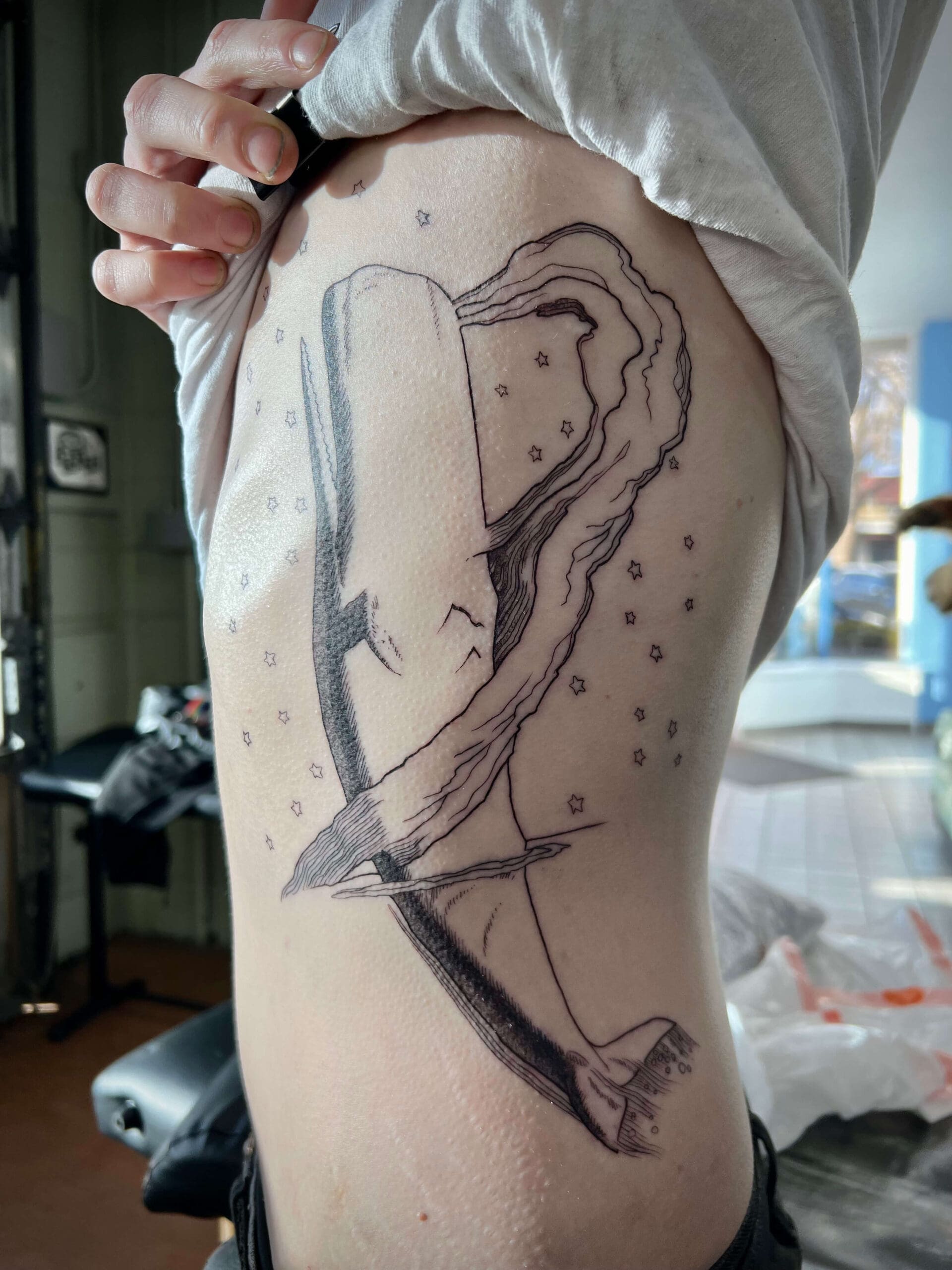
Wind and water backgrounds give Japanese-inspired tattoos direction, atmosphere, and visual unity. They do more than fill empty skin around dragons, tigers, koi, flowers, masks, and warriors.
Water can suggest continuous movement, changing conditions, danger, or persistence. Wind communicates an invisible force through the way it bends plants, carries petals, moves clouds, and directs the viewer’s eye across the body.
Key Takeaways
- Wind and water should support the main subject rather than compete with it.
- Calm water creates a different meaning from breaking waves or turbulent currents.
- Wind becomes visible through clouds, leaves, petals, clothing, and curved background forms.
- Tigers have an established artistic association with wind, while dragons are commonly linked with clouds.
- Directional backgrounds help connect separate subjects across sleeves, back pieces, and chest panels.
- Negative space is necessary to keep dark backgrounds from overwhelming the tattoo.
Why Japanese Tattoo Backgrounds Matter
A large Japanese-inspired tattoo is usually designed as one connected environment rather than a group of isolated images. Background elements establish where the subject exists, how it moves, and what force surrounds it.
Waves can lift a koi, crash around rocks, or frame a dragon. Wind can push cherry petals across a sleeve, bend bamboo around a tiger, or carry clouds behind a mythological figure.
Japanese screen paintings and decorative works also use clouds, waves, and mist to organize space. Gold cloud bands, for example, have been used to separate scenes and divide complex narratives into readable areas.
Tattoo backgrounds perform a similar compositional role. They connect the main subjects while preserving enough separation for each figure, flower, and symbolic object to remain recognizable.
What Does Water Symbolize in Japanese Tattoo Art?
Water does not have one fixed meaning in every Japanese tattoo. Its symbolism changes according to whether it appears as a calm surface, flowing river, waterfall, curling wave, or violent sea.
Flowing water can suggest adaptation and continued movement. The water changes shape around rocks and obstacles without losing its direction.
Strong waves may represent danger, hardship, natural power, or conditions that cannot be controlled completely. Calm water can create a quieter tone connected with reflection, stability, or a period after conflict.
Japanese art has repeatedly used stylized waves as both major subjects and rhythmic decorative forms. Hokusai’s Under the Wave off Kanagawa, first published in 1831, became the most internationally recognized example of a Japanese wave dominating a human scene.
| Water Form | Visual Effect | Possible Tattoo Meaning |
| Calm surface | Quiet and stable | Reflection, control, or recovery |
| Flowing current | Continuous movement | Adaptation and forward progress |
| Waterfall | Strong downward force | Commitment, pressure, or persistence |
| Curling waves | Rhythmic and energetic | Change, natural power, or momentum |
| Breaking waves | Violent and dramatic | Conflict, danger, or hardship |
| Foam and spray | Fast movement | Transition and temporary intensity |
The subject within the water determines whether it appears supported, challenged, protected, or overwhelmed by the environment.
Waves as Power and Movement
Waves give water a visible direction. Their curves can guide the eye from the shoulder to the forearm, across the back, or around the thigh and lower leg.
A high wave placed above a subject may feel threatening. A wave rising beneath a koi or dragon can make the creature appear supported by natural force.
The shape of a wave also establishes emotional tone. Uneven, wavering outlines have been used in Japanese screen painting to suggest the irregular movement of a storm and create an ominous mood.
More regular wave patterns feel controlled and decorative. They can create continuous movement without making the tattoo appear violent.
The artist should decide whether the water is part of the story or mainly part of the structure. A tattoo about overcoming difficulty may need stronger waves than a design focused on balance and peaceful movement.
Calm Water Versus Turbulent Water
Calm and turbulent water should not be used interchangeably because they place the subject in different emotional conditions.
A koi moving through steady water may represent consistent effort. The same fish fighting against a waterfall creates a stronger image of challenge and persistence.
A mask reflected in still water can suggest self-examination or a hidden emotional identity. Placing the mask inside crashing waves creates a more immediate sense of conflict.
| Background Condition | Relationship to the Subject |
| Subject moving with water | Adaptation or aligned progress |
| Subject swimming against water | Persistence and resistance |
| Subject rising above waves | Survival or emerging strength |
| Subject surrounded by still water | Reflection or emotional restraint |
| Subject partly covered by foam | Uncertainty, transition, or danger |
| Subject controlling the current | Authority over changing conditions |
The water should interact with the figure rather than sit behind it as an unrelated pattern.
What Does Wind Symbolize in Japanese Tattoo Backgrounds?
Wind represents force that cannot be seen directly. Its presence becomes visible through movement in clouds, clothing, plants, feathers, hair, smoke, and falling petals.
This allows wind to suggest change, pressure, direction, speed, or an influence that affects the subject without taking a physical form.
A figure moving with the wind may appear adaptable and confident. A subject facing strong wind can represent resistance, endurance, or the decision to continue despite difficult conditions.
Wind can also establish season. Cherry petals carried through the composition suggest spring, while maple leaves moving through wind can establish autumn.
The background should match the movement of the main subject. Wind flowing in the opposite direction can create intentional tension, but accidental directional conflict makes the composition feel disorganized.
What Are Wind Bars?
Wind bars are curved or layered background forms used in Japanese-style tattoo compositions to represent moving air and connect separate images. They may appear beside clouds, petals, leaves, smoke, or open skin.
Their main function is compositional. Wind bars guide the eye around limbs, fill transitions between subjects, and help distinguish the tattoo’s foreground from its background.
They should not become thick black walls around every object. Excessive background saturation can reduce the clarity of flowers, animals, masks, and skin breaks.
Wind bars work best when their direction relates to the anatomy. Curves can follow the shoulder cap, spiral around the arm, or carry movement from the chest into a sleeve.
Common Wind and Water Background Mistakes
One mistake is adding waves to every Japanese-inspired subject without considering whether the character belongs in water. A tiger, Hannya mask, or land-based warrior may need wind, rocks, plants, or clouds instead.
Another is mixing wind, waves, clouds, smoke, and fire without assigning each element a clear environment. Similar curved shapes can become difficult to distinguish.
Direction is another common problem. Waves moving one way, petals moving another, and a figure facing a third direction may create accidental conflict.
The darkest values should not surround every edge of the subject. Strategic skin breaks and lighter transitions keep the composition readable as the tattoo settles.
Frequently Asked Questions
Can a Japanese tattoo background be added around an older tattoo?
Sometimes. The artist must evaluate the existing tattoo’s style, spacing, direction, darkness, and placement before designing the background.
The new work may need to include transitional clouds, rocks, flowers, or open skin rather than placing waves or wind bars directly against every edge.
Can waves wrap around an elbow or knee?
Yes, but the artist must account for bending, stretching, and the changing shape of the joint.
Foam, curved wave sections, and open skin can help disguise minor distortion when the limb moves.
Can Japanese wind and water backgrounds use color?
Yes. Blue, grey, black, green, and limited accent colors can distinguish water from clouds and wind.
The palette should remain subordinate to the main subject so the background does not dominate the tattoo.
Can another artist continue an unfinished Japanese background?
It may be possible, but differences in line weight, grey wash, wave structure, and wind-bar spacing can be noticeable.
The new artist should review healed photographs and the original composition before agreeing to continue it.
Let the Background Control the Tattoo’s Movement
Wind and water symbolism in Japanese tattoo backgrounds comes from the way natural forces affect the main subject. Waves can challenge, support, surround, or carry a figure, while wind can reveal pressure, direction, season, and unseen change.
These elements also solve practical composition problems. They connect separate images, establish depth, guide movement around the body, and preserve visual hierarchy across large tattoos.
Choose the background according to the subject’s environment and emotional role. When wind and water are designed with purpose, they do not sit behind the tattoo. They become the force that makes the entire composition move.