Etched tattoos and traditional linework tattoos both depend on clear outlines, but they use those lines for different purposes.
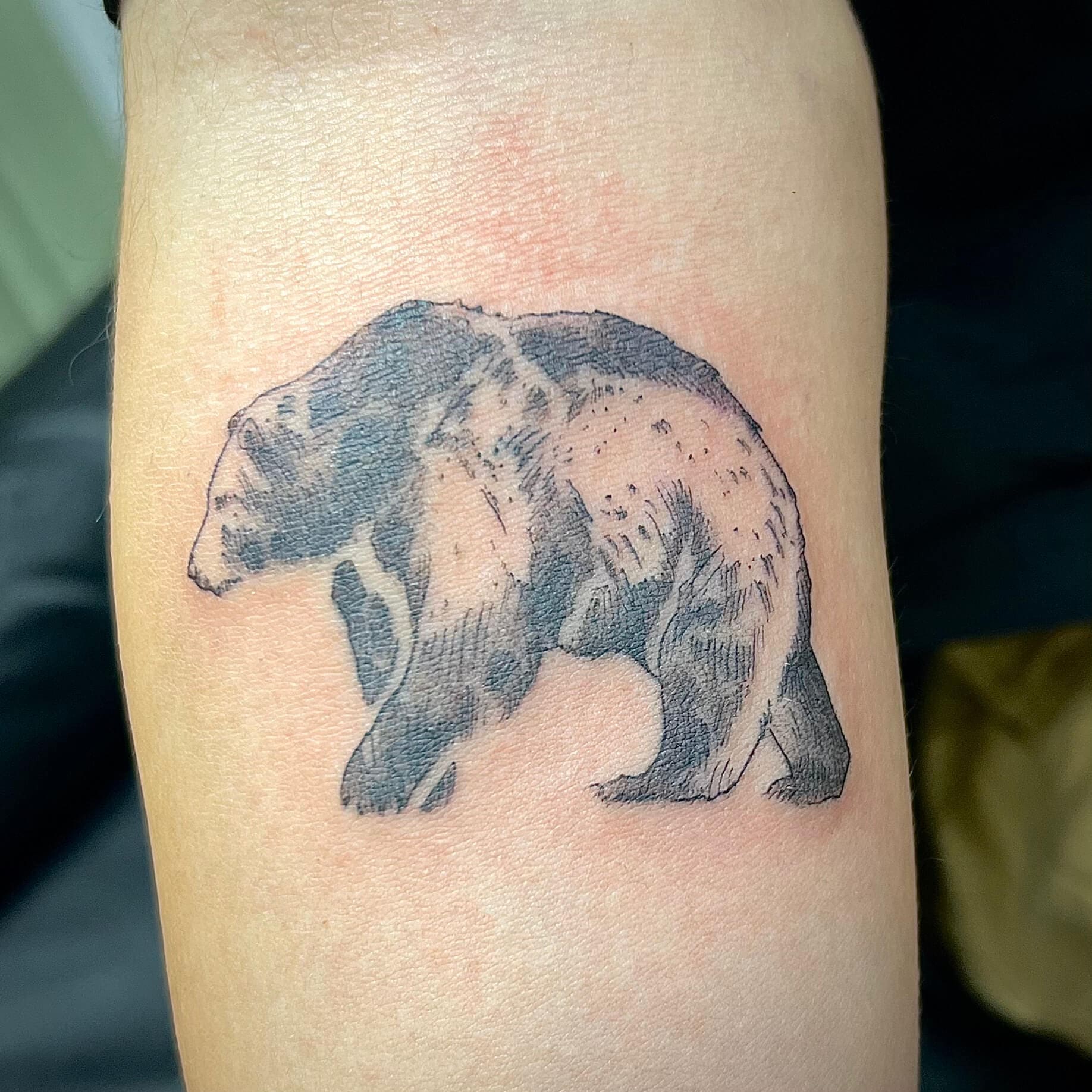
Traditional linework usually defines the shape of the subject before color or shading is added. Etched tattooing uses repeated lines, hatching, stippling, and black shapes to create the subject’s form, texture, and tonal depth.
The better choice depends on the desired appearance, subject, scale, placement, and amount of detail the design needs.
Key Takeaways
- Traditional linework emphasizes bold outlines and immediate readability.
- Etched tattoos build shadows and textures through visible marks.
- Engraving-style designs usually require more spacing and scale.
- Etched tattoos often suit historical, anatomical, botanical, and symbolic imagery.
- Both styles can age well when line weight and spacing match the design.
- The artist’s healed portfolio is more useful than the style label alone.
What Is Traditional Tattoo Linework?
Traditional linework uses outlines to define the subject’s main shapes.
The lines are often bold, consistent, and easy to read from a distance. They may surround solid color, black shading, or open skin.
Traditional linework is commonly associated with designs such as roses, daggers, animals, skulls, ships, hearts, and banners.
The outline creates a strong boundary between each object. This helps the tattoo retain its shape even when color or smaller details soften over time.
Traditional linework does not always mean American traditional tattooing. Artists may use clear, simplified outlines in illustrative, neo-traditional, blackwork, and other styles.
What Makes Etched Tattoo Linework Different?
Etched tattoo linework does more than define the outside of the image.
The artist uses contour lines, parallel hatching, cross-hatching, stippling, and small black areas to create light, shadow, surface, and dimension.
The lines remain visible as part of the finished artwork. They may follow the curve of a skull, the folds of fabric, the direction of fur, or the structure of a flower.
This gives the tattoo the appearance of an old engraving, scientific plate, botanical illustration, or printed manuscript.
The subject may still have a clear outer contour, but much of its identity comes from the internal line system.
Main Differences at a Glance
| Feature | Etched Tattoo | Traditional Linework Tattoo |
| Primary visual feature | Hatching and printed texture | Strong outlines |
| Shading | Cross-hatching, stippling, black accents | Solid black or smoother shading |
| Line weight | Often varied | Usually bold and consistent |
| Best scale | Medium to large for detailed designs | Flexible across many sizes |
| Common subjects | Anatomy, botanicals, medieval imagery, architecture | Roses, animals, daggers, ships, hearts |
| Color use | Often black or limited color | Frequently supports bold color |
| Main aging concern | Dense lines merging | Heavy outlines spreading or softening |
| Overall appearance | Detailed and historical | Bold and immediately readable |
Texture and Surface Detail
Traditional linework usually keeps surface detail simple.
A rose may have a bold outer contour, several internal petal lines, and solid shading. The design remains readable because each major shape is clearly separated.
Etched tattoos create texture through repeated directional marks.
A rose may contain curved hatching inside every petal, stippling around the center, and cross-hatching in the deepest folds.
Animal fur, feathers, stone, metal, fabric, wood, and bone can each receive a different line treatment.
This allows etched designs to show more material variation, but it also requires more careful spacing.
Too many marks can make separate textures look alike or cause the image to appear crowded.
Shading Methods
Traditional tattoos often use solid black, whip shading, or smooth tonal transitions.
The shading usually supports the outline rather than becoming the main visual feature.
Etched tattoos build most shadows through visible lines and dots.
Parallel hatching creates light and middle values. Cross-hatching deepens selected shadows, while stippling can soften transitions into open skin.
Solid black may still appear in deep recesses, clothing, backgrounds, or small focal accents.
| Shading Method | Etched Tattoo Use | Traditional Linework Use |
| Parallel hatching | Main method for form and midtones | Uncommon |
| Cross-hatching | Deep shadow and texture | Rare |
| Stippling | Atmospheric or gradual shading | Occasional |
| Solid black | Structural accents and deepest values | Common |
| Smooth shading | Usually limited | Common |
| Open skin | Highlights and separation | Highlights and interior space |
Neither shading method is automatically better. The choice should match the desired style and subject.
Line Weight and Visual Hierarchy
Traditional linework often uses a heavy outer outline with smaller internal lines.
This creates immediate hierarchy. The viewer sees the main shape before noticing the internal features.
Etched tattoos may use more variation.
The outer contour can be slightly stronger, while internal lines change in thickness and density according to lighting, depth, and material.
This variation can create a refined appearance, but the main silhouette should still remain clear.
An etched tattoo made entirely from equally thin lines may lack contrast. A traditional tattoo made from equally heavy lines may feel flat or overly dense.
Both styles benefit from intentional hierarchy.
Scale and Detail Requirements
Traditional linework adapts well to many tattoo sizes because the design can be simplified around a few bold shapes.
A small rose, dagger, animal head, or heart can remain recognizable with limited internal detail.
Etched tattoos usually need more room when the concept contains dense shading, architecture, lettering, faces, or several figures.
A small etched design can still work, but it should focus on one subject with fewer hatch lines and wider skin breaks.
Trying to compress a full engraving into a small tattoo may cause shadows, textures, and facial details to merge.
The scale should be based on complexity rather than the style name.
Color Differences
Traditional linework is often designed to contain bold areas of color.
Strong outlines separate red, yellow, green, blue, black, and open skin while protecting the design’s structure.
Etched tattoos are commonly created in black because monochrome linework closely resembles historical prints.
Sepia, muted red, brown, and limited palettes may also be used.
Color in an etched tattoo usually supports the linework rather than filling every section.
A red flower, banner, flame, or sacred heart can create emphasis without changing the overall printed appearance.
Placement Considerations
Traditional linework can remain readable across a wide range of placements.
Bold isolated designs often work well on the forearm, calf, upper arm, shoulder, thigh, hand, or chest.
Etched tattoos usually benefit from placements with enough uninterrupted space for internal lines.
The forearm, calf, upper arm, thigh, chest, and back can support detailed designs.
Highly curved or high-friction areas may require simpler hatching and stronger contours.
Circular engravings also need careful placement. A seal, sun, or celestial diagram may distort when wrapped around a narrow limb.
The artist should adapt the composition to the body rather than apply the same drawing to every placement.
How the Styles Age
Both etched tattoos and traditional linework tattoos can age well when they are designed and applied correctly.
Traditional linework has the advantage of bold outlines and simplified forms. Even if the edges soften, the main subject can remain recognizable.
Etched tattoos depend more heavily on the spacing between internal marks.
Dense hatching, narrow skin breaks, and tiny facial details may lose separation when the design is too small.
This does not mean etched tattoos always age worse. A well-spaced engraving with a strong silhouette may remain clearer than a poorly executed traditional tattoo.
Which Style Is Better for Cover-Ups?
Traditional linework can support cover-ups because bold outlines, solid black, and color help conceal existing ink.
Etched designs may also work when they include enough blackwork, texture, and scale.
A delicate engraving made mostly from open fine lines may not provide sufficient coverage.
The existing tattoo’s darkness, color, size, and location will determine which approach is suitable.
The artist may combine bold outer shapes with engraved internal texture to balance coverage and style.
Frequently Asked Questions
Can a traditional tattoo be restyled with etched shading later?
Sometimes. The artist must assess the available open space, existing line weight, and whether new hatching would improve or crowd the design.
Does etched tattooing require a different tattoo machine?
Not necessarily. Artists choose machines, needles, and settings according to their experience and the required line weight rather than the style name alone.
Can etched linework be combined with traditional lettering?
Yes. Banners and bold lettering can provide contrast against finer engraved textures when the typography suits the composition.
Which style is better for someone getting a first tattoo?
Neither style is universally better for a first tattoo. The decision should be based on the desired image, placement, size, artist, and willingness to support the required detail.
Choose the Line System That Fits the Design
Traditional linework creates strength through bold outlines, simplified shapes, and immediate readability.
Etched tattooing creates depth through hatching, stippling, varied line weight, and printed texture.
The best approach depends on what the subject needs. A small, colorful emblem may suit traditional linework, while an anatomical plate or medieval scene may benefit from an engraved treatment.
Choose an artist who can show healed examples in the style you prefer. Clear design structure matters more than the label attached to the technique.