
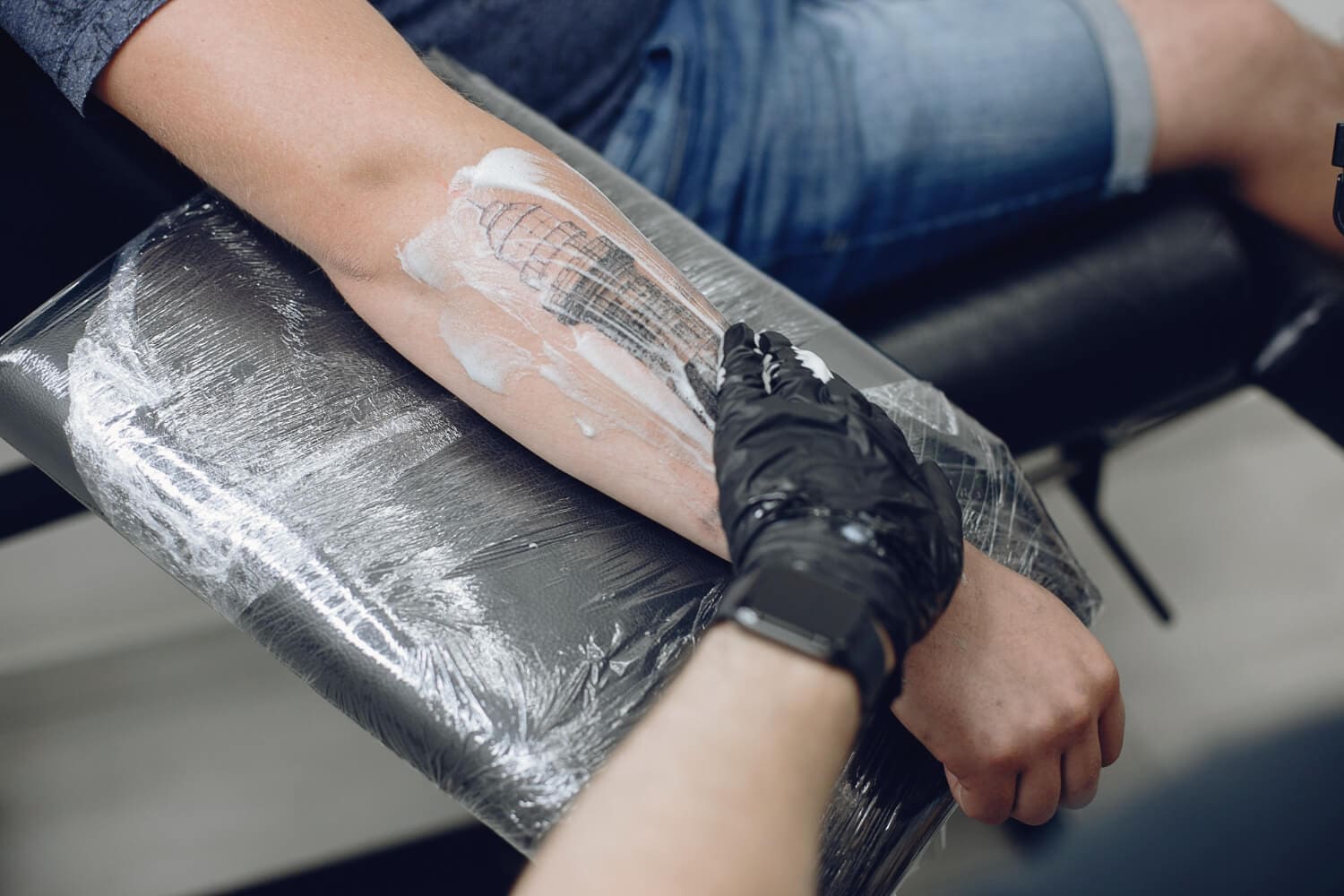
A new tattoo should stay comfortably moisturized while it heals, but more lotion is not necessarily better.
For many healing tattoos, applying a thin layer of a simple moisturizer about twice a day is a reasonable starting point. Cleveland Clinic currently recommends moisturizing a new tattoo twice daily during the first several weeks, while the American Academy of Dermatology advises applying a water-based lotion or cream when tattooed skin feels dry.
Your artist’s instructions still matter because tattoo size, placement, dressing type, skin response, and application can change the aftercare routine.
Key Takeaways
- Moisturizing about twice daily is a practical general starting point for many healing tattoos.
- Follow your tattoo artist’s specific instructions when they differ based on the tattoo or dressing.
- Use a thin layer rather than leaving the tattoo coated in a heavy film.
- Apply more moisturizer based on dryness and tightness rather than automatically increasing the amount.
- Fragrance-free, simple products are generally preferable during healing.
- More moisturizer does not make a tattoo heal faster.
- Overly heavy products can leave the skin unnecessarily occluded and irritated.
- Once the tattoo has healed, moisturizing can continue as part of normal skin care.
Why Does a Healing Tattoo Need Moisturizer?
Tattooing creates controlled trauma to the skin.
As the surface begins repairing itself, dryness, tightness, flaking, itching, and light scabbing may develop. Cleveland Clinic identifies itching and flaking as common parts of the early healing process and recommends moisturizing to help prevent excessive dryness, cracking, and bleeding.
Moisturizer supports the skin barrier rather than directly controlling the tattoo pigment.
The goal is to keep the surface comfortable and flexible without keeping it constantly wet or covered in a thick layer of product.
A properly moisturized tattoo may still peel. Moisturizing does not eliminate the normal renewal of the outer skin.
How Often Should You Moisturize a New Tattoo?
For many tattoos, twice a day provides a useful general schedule.
Cleveland Clinic recommends washing and moisturizing a new tattoo twice daily during the first week and continuing that routine through approximately weeks two to four.
That does not mean every tattoo needs lotion at exactly the same hours.
The American Academy of Dermatology gives more condition-based advice, recommending a water-based lotion or cream when tattooed skin feels dry.
Together, these recommendations suggest a practical approach: begin with the artist’s instructions and a modest routine, then pay attention to how the skin feels.
If the tattoo remains comfortable and flexible, adding lotion every hour is unnecessary.
How Much Moisturizer Should You Apply?
Use enough product to leave the skin lightly moisturized without creating a thick visible coating.
The moisturizer should spread easily over the tattoo and absorb rather than sit on top as a heavy layer.
A larger tattoo naturally requires more product than a tiny design, so an exact pea-sized amount cannot apply to every tattoo.
Think in terms of coverage rather than volume.
The skin should not remain covered in a greasy layer that transfers heavily onto clothing long after application.
Applying more product does not provide additional protection simply because the tattoo feels important or delicate.
What Does a Properly Moisturized Tattoo Feel Like?
A comfortably moisturized tattoo should feel less dry or tight after the product is applied.
The skin may still be mildly sensitive, itchy, or flaky because those can be normal parts of healing.
The surface should not feel as though it has been sealed beneath a thick layer of lotion.
| Skin Condition | Possible Adjustment |
| Comfortable and flexible | Continue the current routine |
| Mildly dry before next application | Apply the normal thin layer |
| Tight and noticeably flaky | Check whether another light application is appropriate |
| Constantly greasy | Use less product |
| Product collecting on the surface | Reduce the amount |
| Increasing redness or irritation | Stop assuming dryness is the only issue and assess the reaction |
The goal is balance.
Moisturizing should support the healing skin without becoming the main thing happening on its surface.
Can You Moisturize a Tattoo Too Much?
Yes, using excessive amounts is unnecessary and may leave the tattoo overly occluded.
Cleveland Clinic specifically warns against petroleum jelly during tattoo healing because it can block pores and potentially contribute to bacterial overgrowth and inflammation. It recommends a more pore-friendly moisturizer instead.
A tattoo does not need to look glossy throughout the entire day.
Repeatedly adding lotion before the previous application has absorbed can leave the area sticky and uncomfortable.
Heavy product can also combine with sweat, clothing friction, and normal skin debris.
If the tattoo is constantly wet-looking despite having been moisturized long ago, you may be applying too much.
What Type of Moisturizer Should You Use?
Simple products are generally the better choice during healing.
The American Academy of Dermatology recommends water-based lotion or cream when tattooed skin becomes dry.
Cleveland Clinic similarly recommends a simple moisturizer or the ointment advised by the tattoo artist.
Avoid assuming that an expensive tattoo-branded product is automatically superior.
The skin primarily needs appropriate moisture without unnecessary irritation.
Strong fragrance, decorative ingredients, exfoliating products, and complicated active skincare routines are usually poor additions to already sensitive healing skin unless specifically recommended by a healthcare professional.
If your artist provides or recommends a product, ask how much to use and for how long.
Should You Moisturize Immediately After the Tattoo?
Follow the instructions for the dressing applied by your artist.
Many fresh tattoos leave the studio covered, and the dressing may remain in place for a period determined by its type and the artist’s protocol.
Cleveland Clinic advises following the artist’s instructions for how long the bandage should remain on before beginning routine washing and moisturizing.
Do not repeatedly lift an adhesive film simply to add moisturizer underneath it.
Once the dressing is removed according to instructions, cleaning and moisturizing can begin based on the recommended aftercare routine.
Different bandage systems require different handling, so generic advice should not override instructions for the specific dressing on your tattoo.
Moisturizing During the First Week
The first week often includes the most noticeable tenderness, redness, dryness, and early flaking.
Cleveland Clinic recommends gentle washing twice daily followed by moisturizing during this stage.
Wash your hands before touching the tattoo.
After gently cleaning the area, pat it dry rather than rubbing it aggressively.
Apply the moisturizer once the tattoo is appropriately dry according to the routine your artist has provided.
Do not repeatedly wash the tattoo every time you want to moisturize unless your aftercare instructions specifically tell you to do so.
Overhandling can be as unnecessary as over-moisturizing.
When Dryness May Be Something Else
Dry or itchy skin is common during tattoo healing, but not every reaction should be treated by simply adding more moisturizer.
Increasing redness, worsening pain, significant drainage, odor, increasing heat, fever, or red streaking require medical attention rather than another layer of lotion. Cleveland Clinic lists these among warning signs that should be evaluated by a healthcare professional.
A rash or persistent irritation may also represent a reaction to ink or a skincare product.
If a moisturizer appears to make redness, burning, swelling, or itching noticeably worse, stop assuming the tattoo only needs additional hydration.
Contact your artist for information about the products used and seek medical advice when symptoms are concerning or persistent.
Frequently Asked Questions
Should I moisturize my tattoo before going to bed?
You can apply a thin layer as part of your normal aftercare schedule if the tattoo needs moisture. Avoid applying an unusually heavy layer simply because you will be asleep for several hours.
Can I switch moisturizers while my tattoo is healing?
You can, but introducing unnecessary new products may make it harder to identify the cause if irritation develops. A simple product that your skin tolerates is usually preferable.
Should I moisturize over tattoo scabs?
A light application over the healing area may be part of normal aftercare, but do not massage, soften, or deliberately remove scabs. Allow them to separate naturally.
Does a color tattoo need more moisturizer than a black and grey tattoo?
Not automatically. Moisturizing needs depend more on the condition, size, placement, and healing response of the skin than whether the pigment is color or black and grey.
Keep the Tattoo Comfortable, Not Constantly Coated
For many new tattoos, moisturizing about twice a day with a thin layer is a useful starting point, particularly during the first several weeks. Your artist may adjust that routine based on the tattoo and dressing used.
Pay attention to the skin rather than trying to keep the tattoo permanently glossy.
Apply enough moisturizer to relieve dryness and tightness, then allow the product to absorb. Do not assume that frequent heavy applications will speed healing or preserve more ink.
As peeling and sensitivity decrease, tattoo-specific moisturizing becomes less intensive. Once healed, continue moisturizing when the skin feels dry as part of ordinary skin care.