
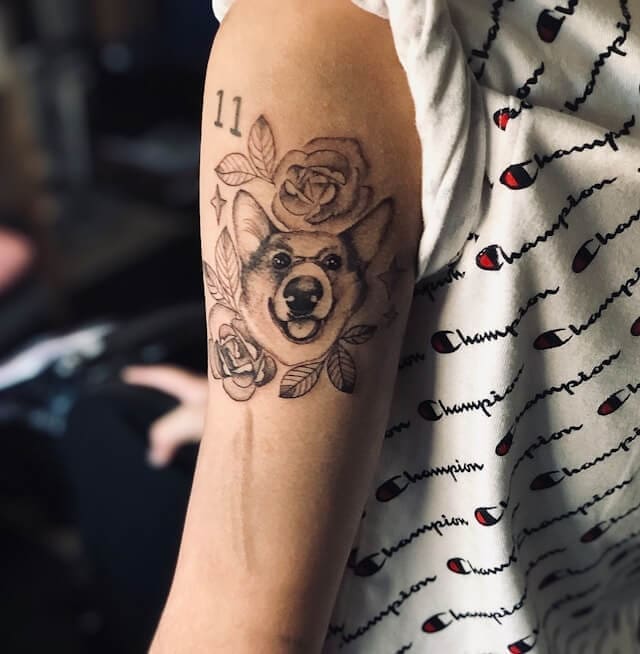
A pet memorial tattoo can preserve the personality, habits, and memories connected to an animal that became part of your daily life.
The strongest designs usually go beyond simply tattooing a paw print or name. They use details that make the animal recognizable to you, such as a favorite toy, sleeping position, collar tag, distinctive markings, or place you shared.
A memorial tattoo does not need to explain the entire relationship. One carefully chosen image can carry years of memory.
Key Takeaways
- Pet memorial tattoos can use portraits, paw prints, handwriting, objects, flowers, landscapes, or symbolic imagery.
- Personal details often create stronger memorials than generic pet symbols.
- A portrait requires enough size and an artist experienced with likeness.
- Paw prints should ideally come from an actual print rather than a generic online image.
- Collars, tags, toys, and other everyday objects can create subtle memorial tattoos.
- Dates can be included, but they do not need to become the focal point.
- The best design should still feel meaningful even when strangers do not understand its full story.
Start With What Made Your Pet Recognizable
Before choosing a tattoo style, think about what made the animal uniquely yours.
It may have been the shape of a dog’s ears, a cat’s unusual facial marking, a rabbit’s favorite sleeping position, or the way a bird tilted its head.
These small characteristics can become more emotionally powerful than a generic symbol associated with pets.
A portrait can preserve the animal’s appearance, while an object or silhouette can represent its personality more indirectly.
The right approach depends on what you want to remember most.
Pet Portrait Tattoo Ideas
Portrait tattoos offer one of the most direct ways to memorialize an animal.
A realistic portrait can preserve facial expression, fur pattern, eyes, ears, and other recognizable features.
The reference photograph matters significantly.
Choose an image with clear lighting, visible facial features, and enough resolution for the artist to understand the animal’s structure. A blurry photograph may still carry emotional value, but the artist may need additional images to recreate details accurately.
Portraits should also be given enough space.
Trying to fit a detailed dog or cat face into an extremely small tattoo can reduce the amount of information the artist can preserve.
| Portrait Approach | Visual Effect | Best For |
| Realistic portrait | Detailed likeness | Clear photographs and larger placements |
| Black and grey portrait | Soft, focused memorial | Fur texture and expressive faces |
| Fine line portrait | Delicate interpretation | Simpler facial structure |
| Illustrative portrait | Personalized artistic style | Clients wanting less realism |
| Minimal silhouette | Simple recognition | Strong profiles or distinctive ears |
Choose an artist whose healed portfolio includes animal portraits if likeness is the main priority.
Use the Actual Paw Print
Paw-print tattoos are common because they represent physical contact with the animal.
Using the pet’s actual paw print can make the design much more personal.
Veterinary clinics, memorial services, shelters, or pet owners may already have an ink or clay impression. An artist can use that source to create a tattooable version.
The print does not need to remain perfectly rough or uneven.
The artist may clean small imperfections while preserving the overall shape and identifiable pad structure.
If no real print exists, consider another personal detail rather than choosing a random paw image online and presenting it as your pet’s print.
Nose Print Tattoos
A dog or cat’s nose pattern can create another highly personal memorial.
Like fingerprints, nose textures contain distinctive grooves and shapes.
If a clear print or close photograph exists, an artist may be able to simplify it into a tattoo design.
This can be especially meaningful for someone who wants a memorial that does not immediately look like a conventional pet tattoo.
The design may appear as an abstract texture until the wearer explains its origin.
Collar and Tag Tattoos
A collar or identification tag can represent years of everyday companionship.
A simple tag may include the pet’s name, initials, or recognizable shape.
Some people choose to tattoo the actual outline of a worn tag, including scratches or imperfections.
A collar can also become part of a portrait.
Instead of focusing only on the animal’s face, the artist may include the familiar band, buckle, bell, or tag visible in old photographs.
These objects often carry emotional weight because they were handled repeatedly during the pet’s life.
Favorite Toy Memorial Tattoos
A favorite toy can create a memorial that feels more playful than traditional remembrance imagery.
A tennis ball may represent a dog that never stopped playing fetch. A worn stuffed animal may immediately remind the family of a pet that carried it everywhere.
Cats may be represented through a favorite mouse toy, feather wand, cardboard box, or ordinary household object they repeatedly claimed.
The object does not need to look important to anyone else.
Its value comes from the memory attached to it.
A small toy tattoo can also work well when the wearer wants something subtle rather than an obvious memorial.
Pet Name and Handwriting Tattoos
Names can be used alone or incorporated into a larger image.
The pet’s name might appear beneath a portrait, inside a collar tag, beside a paw print, or along the stem of a botanical design.
Another option is using handwriting from someone who loved the animal.
A child’s handwritten version of the pet’s name can create a memorial connecting both the pet and family.
Very small handwriting may need to be enlarged or slightly cleaned so the individual letters remain readable.
The emotional character of the writing can still be preserved even when the artist adjusts it for tattooing.
Birth Dates and Memorial Dates
Dates can mark when the pet entered your life, when it was born, or when it died.
Some people prefer using only the birth or adoption date because they want the tattoo to focus on the life rather than the loss.
Others include both dates as a complete memorial.
The numbers can remain secondary.
A date may sit beneath a portrait, around a frame, within a tag, or beside another symbolic image.
Roman numerals can create a more decorative appearance, but verify every conversion before tattooing.
Flowers Connected to Your Pet
Botanical imagery can soften a memorial composition and introduce additional personal meaning.
The flower may represent the pet’s birth month, adoption month, favorite season, or a plant associated with the home.
A dog that spent afternoons beneath a particular tree might be remembered through its leaves.
A cat that regularly sat near a garden window could be represented by flowers grown outside that window.
Flowers also provide useful compositional structure around portraits, paw prints, and names.
The botanical element should support the pet memorial rather than overwhelm it unless the plant itself is part of the story.
Give Yourself Time After the Loss
There is no required waiting period before getting a pet memorial tattoo.
Some people want the tattoo immediately because the design helps them process the loss.
Others need months or years before they know what image feels right.
Neither response is incorrect.
Waiting can be helpful when several ideas feel emotionally overwhelming or when you are unsure whether you want the tattoo to focus on grief, memory, personality, or the life you shared.
The design may become clearer once the most painful stage of loss has changed.
Frequently Asked Questions
Can pet ashes be mixed into tattoo ink?
Some services and studios advertise memorial tattoo processes involving cremated remains, but practices, safety considerations, and regulations vary. Discuss the idea directly with a qualified artist and follow applicable health requirements before making a decision.
Can a pet portrait be created from several photographs?
Yes. An artist may use several images to understand markings, facial structure, and expression when no single photograph contains everything needed.
Can I tattoo my pet while they are still alive?
Yes. A pet-honor tattoo does not need to be created only after death. Many people choose portraits, paw prints, or symbols while their animal companion is still part of their daily life.
Can an old pet memorial tattoo be expanded later?
Yes. Flowers, landscapes, frames, additional animals, or other symbols can be added when the original placement leaves enough usable space.
Memorialize the Relationship, Not Just the Loss
A pet memorial tattoo does not need to center on the final day of an animal’s life.
It can preserve the way they looked at you, the toy they carried everywhere, the trail you walked together, or the ordinary place where they slept every afternoon.
Portraits and paw prints create direct memorials, while flowers, objects, landscapes, and silhouettes can carry the same meaning more privately.
Choose the detail that makes you remember the animal as an individual.
The strongest pet memorial tattoo is not simply recognizable as a memorial. It feels unmistakably connected to the companion you are honoring.