
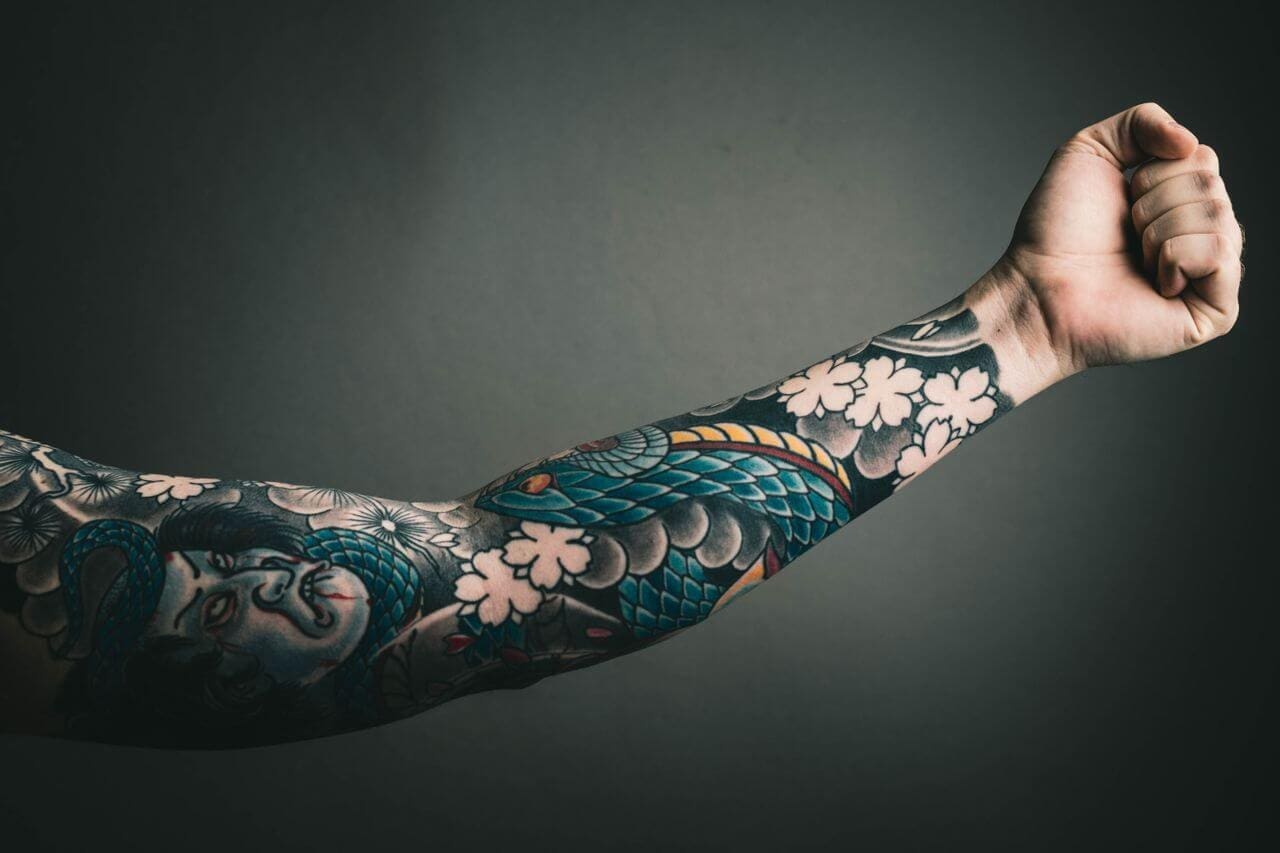
Irezumi is commonly translated as “Japanese tattoo,” but the word carries more weight than that simple definition suggests.
Depending on the period, speaker, and context, irezumi can refer broadly to tattooing, specifically to Japanese-style tattooing, or to a permanent body practice shaped by social stigma and historical associations.
Understanding the term requires separating its literal meaning from related words such as horimono, wabori, and tebori. It also means recognizing that Japanese speakers, tattoo artists, researchers, and international tattoo communities do not always use these terms in exactly the same way.
Key Takeaways
- Irezumi is written in several forms and broadly refers to tattooing or permanent ink placed in the skin.
- Outside Japan, the term often refers specifically to traditional Japanese-style tattoos.
- Historical sources sometimes distinguish punitive irezumi from decorative horimono, but usage has changed over time.
- Horimono emphasizes the idea of carving and often describes unified decorative body compositions.
- Tebori refers to hand tattooing, not to a separate tattoo style.
- Wabori generally refers to Japanese-style tattooing and may be completed by hand, machine, or both.
- Irezumi has carried meanings connected with identity, community, resistance, exclusion, and artistic commitment.
- Traditional Japanese tattooing should not be reduced to organized crime imagery.
What Does the Word Irezumi Literally Mean?
One common written form is 入れ墨, combining language associated with putting or inserting something with the character for ink.
The National Diet Library records 入墨 with the reading irezumi. It also lists related or variant terms including いれずみ, タトゥー, 刺青, 文身, 彫物, and the English term “tattooing.” This range of entries shows that Japanese tattoo terminology has never depended on only one written form.
“Irezumi” is therefore often explained as “inserting ink” or “putting ink into the skin.” That translation describes the physical action more closely than definitions that describe the process as painting the skin.
However, even the literal translation does not fully explain how the term functions socially. A word can describe a physical process while also carrying historical and cultural associations created by the people who use it.
Why Irezumi Is Difficult to Translate Precisely
Japanese tattoo terminology is complicated because several words overlap without being completely interchangeable.
Research published by the Japanese Society for Aesthetics describes irezumi as an ambiguous term. The study notes that tattooing has also been called horimono, meaning something carved, even though tattooing is not literally sculpture or painting.
The process uses needles to puncture the skin and deposit pigment. The language of carving nevertheless became important because it reflects how Japanese tattoo artists and wearers understood the depth, permanence, craftsmanship, and bodily structure of the work.
The same research connects tattoo terminology with a “costume” aspect. Large Japanese tattoos can function visually like a garment constructed across the body rather than like individual images placed independently.
As a result, translating irezumi only as “tattoo” may lose part of its artistic and social context. Translating it as “traditional Japanese tattoo” may also be too narrow when the speaker is using the word more generally.
Irezumi and Tattoo in Modern Japanese Usage
Modern Japanese includes both irezumi and the loanword tattoo, commonly rendered as tattsū.
An ethnographic study of tattooed young people in Japan explains that the two words can refer to the same basic process but may suggest different visual and cultural categories. Within the framework used by that study, “tattoo” was associated more strongly with Western-style tattooing, while irezumi was associated with Japanese-style tattooing.
The same study emphasizes that this boundary is not clear in contemporary practice. Artists and clients may mix Japanese and Western techniques, subjects, and terminology, making a strict separation difficult.
Outside Japan, irezumi has become a popular label for tattoos using traditional Japanese motifs and body compositions. This international use is understandable, but it can make the term appear more precise than it is within Japanese language and history.
Was Irezumi Originally a Punitive Term?
Some historical scholarship distinguishes irezumi from horimono by connecting the first term with punitive marking and the second with voluntary decoration.
Tattooing was used to mark people convicted of crimes during parts of Japanese history. Decorative tattooing also developed among urban commoners, workers, firefighters, and other groups, creating a contrast between imposed marks and chosen body art.
Within this distinction, irezumi could carry the negative meaning of ink inserted as punishment, while horimono described elaborate pictorial tattoos selected by the wearer.
That difference should not be treated as a fixed rule for every period or speaker. The terminology changed, overlapped, and accumulated new meanings as decorative tattooing developed and as the practice entered modern international culture.
Today, many English-language clients use irezumi positively to describe traditional Japanese tattoo art. A historically negative association does not control every modern use of the word.
Irezumi, Horimono, Wabori, and Tebori
These terms describe related parts of Japanese tattoo culture, but they do not all refer to the same thing.
| Term | Basic Meaning | Common Tattoo Context |
| Irezumi | Inserted ink or tattooing | Broad tattoo term or traditional Japanese tattooing |
| Horimono | Carved thing | Decorative pictorial tattooing and unified body compositions |
| Wabori | Japanese carving | Japanese-style tattoo design and execution |
| Tebori | Hand carving | Tattooing performed with a handheld needle tool |
| Horishi | Carving master or artist | Traditional tattoo practitioner or master |
| Tattoo or tattsū | Western loanword | Often associated with modern or Western-style tattoos |
Horimono emphasizes the idea of the tattoo as something carved into the wearer’s body. The National Diet Library records 彫物, read as horimono, among the variant terms associated with tattooing.
Wabori generally identifies Japanese-style tattooing. A Japan Foundation artist profile describes traditional Japanese tattoo as horimono, irezumi, or wabori, demonstrating how the terms may overlap within professional practice.
Tebori refers to a method rather than a separate visual style. The Japanese American National Museum describes it as traditional Japanese tattooing performed by hand.
An irezumi design can therefore be completed using tebori, an electric tattoo machine, or a combination of both. Calling a tattoo irezumi does not automatically reveal which tools were used.
Irezumi as a Complete Body Composition
Traditional Japanese tattooing often treats the body as one connected visual surface.
A back piece may establish the primary character or story. Sleeves, chest panels, legs, waves, clouds, flowers, wind bars, and open skin can then extend that narrative through the rest of the body.
This structure explains why the clothing or costume comparison is useful. The tattoo does not simply sit on the body. It is shaped around the torso, limbs, joints, and areas normally covered by clothing.
Large compositions may also be designed so they remain concealed beneath everyday clothing. The wearer decides when the complete work becomes visible, creating a distinction between public appearance and private identity.
This compositional system separates traditional Japanese tattooing from simply collecting several Japanese motifs. A koi, dragon, tiger, or peony does not automatically create irezumi when it is placed without the background, seasonal relationships, anatomical flow, or visual hierarchy associated with the tradition.
Irezumi as Personal Identity
A permanent tattoo can become part of how a person understands and presents the self.
In Japan, this decision may carry particular social consequences because tattoos remain associated with exclusion from some public spaces and with negative public judgment. Research on tattooed communities describes tattoos as marks that can marginalize wearers while also strengthening relationships within particular social groups.
This creates a complicated identity rather than a purely rebellious one.
A tattoo may represent personal taste, loyalty, memory, endurance, or belonging. At the same time, the wearer may need to conceal it in workplaces, family settings, public baths, gyms, or other environments.
The meaning of irezumi therefore exists partly inside the design and partly in the wearer’s relationship with society. The same tattoo may communicate pride within one community and produce suspicion within another.
Irezumi and Community Belonging
Tattoo identity is not always individual.
The ethnographic study published in the Japanese Review of Cultural Anthropology found that tattoos helped create special ties among members of a youth community. The tattoos distinguished them from mainstream expectations while reinforcing shared norms and relationships within their own group.
This finding should not be applied to every tattooed person in Japan. It demonstrates that permanent body art can function as communication between people rather than only as private self-expression.
Traditional tattoo communities may also develop around artist lineages, shared appreciation of Japanese art, long-term bodysuit projects, and relationships formed across repeated sessions.
The tattoo becomes evidence of time, trust, and participation in a particular craft culture.
Does Irezumi Mean Yakuza Tattoo?
Irezumi and yakuza tattoos are not interchangeable terms.
Organized-crime associations have strongly influenced the public image of Japanese tattoos. The ethnographic research notes that the connection between the yakuza and irezumi has contributed to social restrictions and negative reactions toward tattooed people in Japan.
Some yakuza members have worn large traditional Japanese tattoos as expressions of commitment, loyalty, strength, or group identity. That history does not mean every wearer of irezumi belongs to organized crime.
Japanese tattooing has also been practiced by laborers, firefighters, artisans, collectors, artists, international clients, and people with no criminal affiliation. Museum and cultural exhibitions present it as an evolving art form with roots in Japanese woodblock printing and contemporary global practice.
Reducing irezumi to yakuza symbolism erases much of its artistic, working-class, and personal history.
What Irezumi Means to Tattoo Artists
For some artists, Japanese tattooing represents a professional lineage as well as a visual style.
Traditional tattoo names frequently use the prefix hori, connected with carving or engraving. A Japan Foundation profile describes an artist receiving the name Horisumi from Horiyoshi III after two decades of tattooing, with the title recognizing dedication and accomplishment in traditional Japanese work.
This type of naming reflects teacher relationships, reputation, training, and continuity within parts of the tattoo community. It is not a universal licensing system followed by every Japanese tattoo artist.
An artist can specialize in Japanese tattooing without holding a traditional name. Likewise, using a name beginning with hori should not replace an evaluation of the artist’s portfolio, healed work, compositional knowledge, and professional practices.
Common Misunderstandings About Irezumi
| Misunderstanding | More Accurate Explanation |
| Irezumi always means a tattoo done by hand | Tebori is the hand tattooing method |
| Every Japanese motif is irezumi | Traditional composition involves more than the central subject |
| Irezumi means yakuza membership | The association exists, but the terms are not synonymous |
| Horimono and irezumi always mean different things | Their uses overlap and vary by context |
| Irezumi has one universal symbolic meaning | Meaning depends on the design, wearer, period, and social setting |
| All Japanese artists use the same terminology | Language varies across artists, regions, generations, and clients |
The most reliable approach is to examine how a particular artist or source uses the term rather than imposing one definition on every situation.
Frequently Asked Questions
Should irezumi be capitalized when written in English?
It is normally written in lowercase because it is a general term rather than a proper name. Capitalization may still appear in titles, branding, or at the beginning of a sentence.
Can a small Japanese-inspired tattoo be called irezumi?
The term may be used broadly, but many artists reserve it for work that follows traditional Japanese composition and imagery. Describing the actual design is often clearer than relying on the label alone.
Is “traditional Japanese tattoo” a complete translation of irezumi?
It is a useful translation in many English-language contexts, but it does not represent every historical or modern use of the Japanese word.
Should clients use Japanese tattoo terminology during a consultation?
Clients can use the terms they understand, but they should also describe the desired subject, composition, background, scale, color, and technique. Clear visual communication is more important than demonstrating specialist vocabulary.
Understand the Word Before Wearing the Style
Irezumi can mean tattooing, Japanese-style tattooing, a complete body composition, or a permanent identity shaped by a particular cultural history.
Its meaning changes according to who uses the word and why. Historical punishment, decorative horimono, artist lineages, community belonging, public stigma, and international tattoo culture have all influenced the term.
Understanding these layers prevents the art from being reduced to a literal translation or a single stereotype.
Choosing irezumi means engaging with more than an image. It means recognizing the language, compositional tradition, social history, and human relationships carried through permanent Japanese tattoo art.