
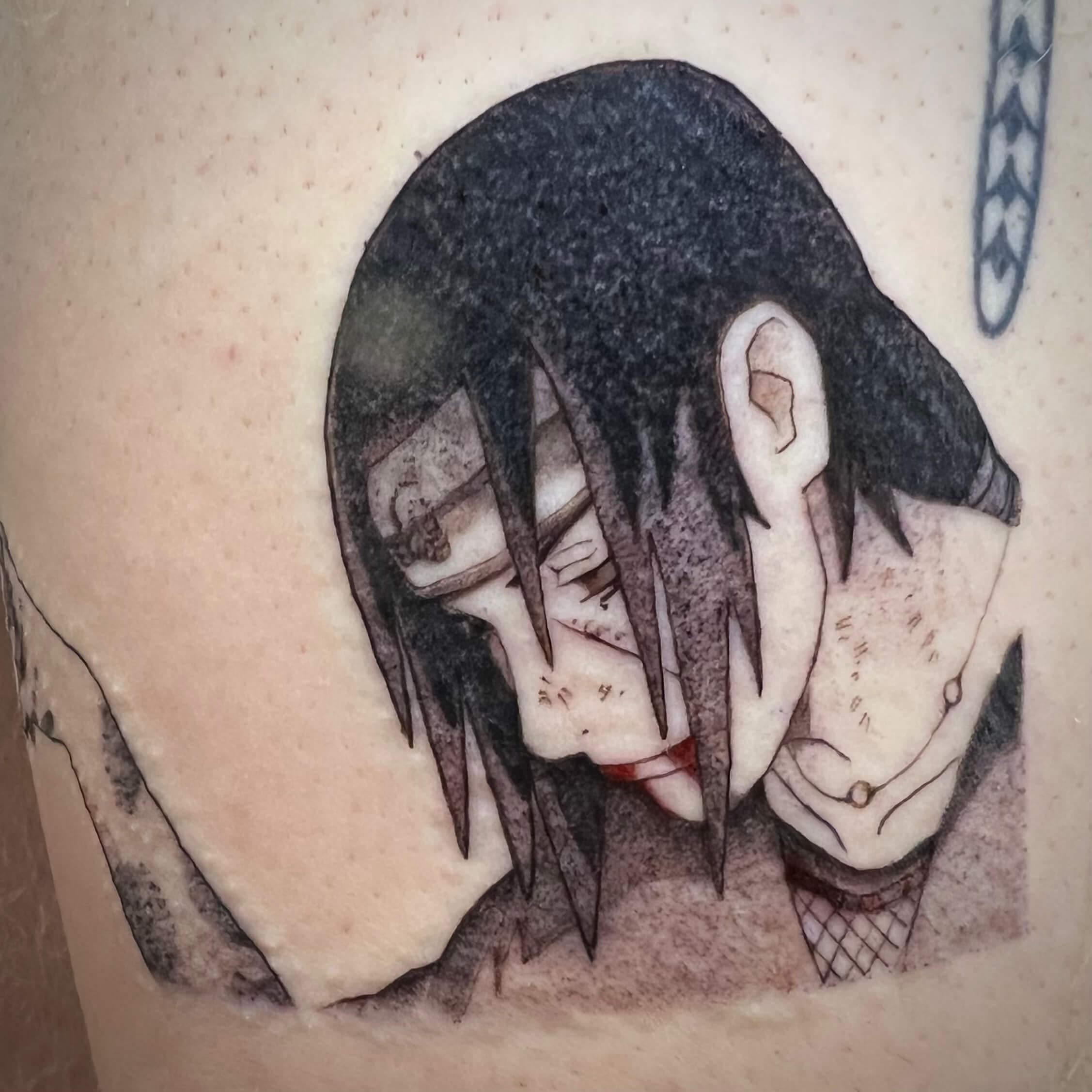
Japanese tattoo culture has never followed one simple path.
Permanent body markings have represented regional identity, punishment, beauty, protection, courage, rebellion, craftsmanship, and organized crime at different points in history. These meanings sometimes existed beside one another rather than replacing each other completely.
Modern Japanese tattooing grew from this complicated history. Its visual language was shaped by folk stories, religious imagery, woodblock prints, working-class culture, government prohibition, underground practice, and international influence.
Key Takeaways
- Tattooing in Japan includes several regional and historical traditions, not one continuous practice.
- Indigenous Ainu tattooing and Ryukyuan hajichi should not be treated as early versions of mainland irezumi.
- Tattoos were used as criminal punishment during parts of Japanese history.
- Decorative tattooing expanded during the Edo period alongside woodblock print culture.
- Images of tattooed heroes from the Suikoden became major artistic references.
- The Meiji government prohibited decorative tattooing in 1872.
- The legal ban ended in 1948, but social stigma continued.
- Modern Japanese tattooing exists between cultural preservation, artistic innovation, and continuing restrictions.
Japanese Tattoo History Is Not One Continuous Tradition
The phrase “Japanese tattoo culture” can create the impression that every tattooing practice in the Japanese archipelago developed from the same source.
Historical evidence presents a more complicated picture. Different regions and communities used permanent markings for different purposes, while mainland decorative tattooing developed through its own social and artistic conditions.
Early written records describe tattooed people in and around the Japanese archipelago. Claims that markings on prehistoric clay figures prove widespread tattooing are more uncertain because carved or painted patterns do not preserve direct evidence from human skin.
A careful history should therefore separate confirmed records from interpretation. It should also avoid turning every regional practice into a starting point for the later full-body tattoo tradition.
Ainu and Ryukyuan Tattooing Have Distinct Histories
Ainu tattooing belongs to the history and culture of the Ainu, the Indigenous people of northern Japan and surrounding regions.
Women traditionally received facial and hand markings connected with community, adulthood, beauty, spirituality, and the afterlife. These practices should be understood within Ainu culture rather than presented simply as ancient Japanese decorative tattooing.
The Ryukyu Islands developed another distinct tradition known as hajichi. These tattoos were commonly placed on women’s hands and carried meanings connected with identity, protection, maturity, beauty, and life within Ryukyuan society.
Okinawa’s cultural heritage authorities describe hajichi as a lost traditional tattooing culture whose origins, regional patterns, and meanings remain connected to the history of the Ryukyu Islands. The practice declined after suppression under Japanese rule, but current cultural projects are recovering its memory.
Ainu tattooing, Ryukyuan hajichi, and mainland decorative tattooing may appear together in a broad history of tattooing in Japan. They should not be blended into a single tradition without recognizing their separate cultural contexts.
Tattooing as Punishment and Social Exclusion
Tattooing did not always represent voluntary decoration.
During different periods, authorities used permanent marks to identify and punish people convicted of crimes. The placement and appearance of these marks could vary by location and offense.
Punitive tattooing transformed the body into a public record. Unlike clothing or restraints, the mark remained after a sentence ended and could continue to affect the person’s place in society.
This history contributed to the long association between tattoos, criminality, and exclusion. It also created an important distinction between tattoos imposed by authorities and decorative tattoos chosen by the wearer.
During the Edo period, punitive marking and voluntary decorative tattooing existed within the same society. One did not develop only after the other disappeared.
The Rise of Decorative Tattooing During the Edo Period
The Edo period, generally dated from 1603 to 1868, created the conditions in which large-scale decorative tattooing developed into a recognizable art form.
Cities expanded, commercial print culture flourished, and popular audiences gained access to illustrated stories, actors, heroes, religious figures, animals, flowers, and supernatural subjects.
Decorative tattoos became associated with parts of the urban working population, including laborers and firefighters. Large designs could express toughness, loyalty, courage, protection, personal taste, or identification with admired heroes.
These tattoos were often arranged to cover broad areas while remaining hidden beneath normal clothing. The body could function like a private illustrated garment revealed only in selected settings.
Research cataloged by Japan’s National Diet Library notes that Japanese tattoo terminology has long carried a connection with carving and with the visual effect of costume. This helps explain why traditional body compositions are often discussed as unified coverings rather than collections of unrelated images.
Ukiyo-e and the Tattooed Heroes of the Suikoden
Woodblock printing had a major influence on the composition and imagery of Edo-period tattooing.
Ukiyo-e artists created bold figures, dynamic movement, patterned clothing, dramatic backgrounds, and clearly separated colors. Tattoo artists could translate similar visual principles into designs that moved across the back, chest, arms, and legs.
Museum collections preserve numerous Edo-period images of these tattooed heroes. The British Museum holds Utagawa Kuniyoshi prints showing figures such as Zhang Heng, Ruan Xiaowu, Mu Chun, and Du Xing with extensive body decoration.
The Metropolitan Museum of Art also holds an 1854 print by Utagawa Kunisada in which a kabuki actor is compared with Shi Jin, the “Nine Dragoned” hero whose body carries a pattern of nine dragons.
These prints did more than provide individual motifs. They demonstrated how animals, warriors, flowers, waves, clouds, and background elements could form one continuous visual field.
From Isolated Motifs to Full-Body Composition
Japanese decorative tattooing became known for treating the body as a complete compositional surface.
A central back image could establish the main story. Sleeves, chest panels, thigh coverage, wind bars, clouds, waves, flowers, rocks, and open skin could then connect the design across the body.
This approach differs from placing several separate tattoos beside one another. Each section contributes to a larger visual rhythm and narrative.
Dragons, tigers, koi, snakes, warriors, Buddhist figures, masks, peonies, chrysanthemums, maple leaves, and waves became enduring subjects because they could carry meaning while filling broad anatomical areas.
Their historical use does not give every motif one fixed interpretation. Meaning changes according to the character, story, seasonal pairing, direction, placement, and relationship between subjects.
Japanese Tattoo Culture Beyond Japan
Japanese tattoo imagery now influences artists and clients around the world.
International studios produce full sleeves, back pieces, bodysuits, and individual designs inspired by Japanese composition. Some artists follow traditional visual rules closely, while others combine Japanese motifs with realism, blackwork, fine line, or contemporary illustration.
This global popularity has helped preserve interest in ukiyo-e, tebori, traditional backgrounds, and large-scale body planning.
It has also created questions about cultural knowledge. Using a dragon, deity, mask, sacred figure, or folklore character without understanding its source can turn a historically specific image into generic decoration.
Respect begins with research. A responsible design should consider the original story, cultural context, seasonal relationships, body composition, and whether the artist has experience with Japanese-inspired work.
Japanese Tattoo History at a Glance
| Period or Context | Role of Tattooing |
| Early written records | Descriptions of tattooed peoples and regional practices |
| Ainu and Ryukyuan traditions | Community, identity, spirituality, beauty, and life stages |
| Punitive systems | Permanent identification and social exclusion |
| Edo period | Expansion of decorative and full-body tattooing |
| Nineteenth-century print culture | Popularization of tattooed heroes and narrative imagery |
| Meiji period | National prohibition and underground continuation |
| Post-1948 Japan | Legal practice with continuing stigma |
| Contemporary culture | Preservation, global influence, experimentation, and gradual change |
Frequently Asked Questions
Did samurai commonly wear full-body Japanese tattoos?
Evidence does not support treating full-body tattooing as a standard samurai practice. Decorative tattoo culture became more strongly associated with urban commoners, workers, performers, and other groups.
Were traditional Japanese tattoos always completed by hand?
Hand tattooing became an important traditional technique, but modern Japanese artists may use machines, tebori, or a combination of both.
Why are some Japanese tattoos designed to stop before the wrists and neck?
Traditional coverage could remain hidden beneath clothing, creating a complete private composition without making the tattoo continuously visible in public.
Did Western tattooing influence modern Japanese artists?
Yes. Contact with foreign artists, machines, pigments, photography, conventions, and international clients contributed to modern exchange while traditional Japanese methods continued.
Japanese Tattoo Culture Survived by Changing
The history of Japanese tattoo culture is not a simple movement from ancient ritual to modern art.
It contains separate Indigenous traditions, forced punishment, voluntary decoration, working-class identity, woodblock-print influence, prohibition, underground survival, criminal stigma, and global artistic recognition.
Japanese tattooing endured because artists and wearers continued adapting it. They preserved established imagery and compositional principles while responding to new laws, tools, audiences, and cultural attitudes.
Understanding that history changes how the art is viewed. A Japanese tattoo is not merely a collection of popular motifs. It belongs to a visual tradition shaped by centuries of conflict between private meaning, public judgment, artistic craftsmanship, and permanent commitment.