
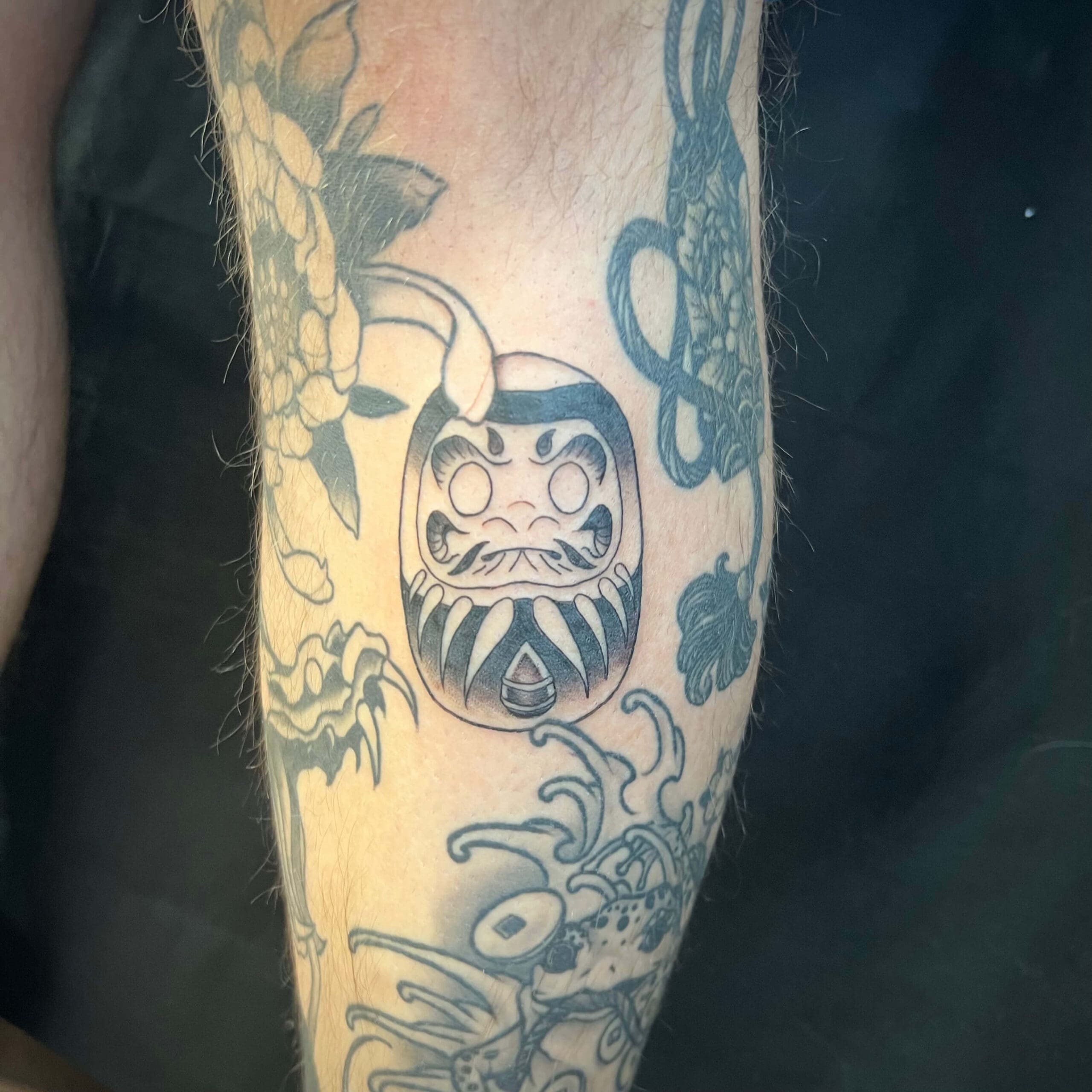
Forearm tattoos work well for designs that need visibility, directional flow, and enough space for recognizable detail. The area can support lettering, portraits, botanical work, symbolic imagery, black and grey shading, or larger compositions that connect the wrist to the elbow.
The best design depends on which side of the forearm is used. Inner, outer, and wraparound placements offer different visibility, movement, pain levels, and composition opportunities.
Key Takeaways
- Inner forearm tattoos suit personal, text-based, and vertically arranged designs.
- Outer forearm placements provide a flatter surface for bold imagery and stronger contrast.
- Wraparound tattoos create movement but require careful planning around the arm’s rotation.
- Long designs should follow the direction of the forearm instead of being squeezed across it.
- Lettering, faces, and symmetrical subjects must be checked in a natural arm position.
- Future sleeve plans should be considered before filling the entire forearm.
Why the Forearm Works Well for Tattoos
The forearm provides a long, visible area between the wrist and elbow. It offers more usable space than the hand while remaining easier to display than the upper arm, chest, back, or thigh.
The area also supports several design orientations. Artwork can run vertically, sit as a centered panel, wrap around the arm, or connect with existing wrist and upper-arm tattoos.
Forearm tattoos are easy for the wearer to see. This makes the placement popular for memorial designs, meaningful quotes, personal symbols, and artwork intended to serve as a regular visual reminder.
The main limitation is visibility. Even when covered by long sleeves, forearm tattoos may become exposed during movement, warm weather, or certain work tasks.
Wraparound Forearm Tattoo Ideas
Wraparound designs use several sides of the forearm to create movement. They may spiral, form a band, connect front and back panels, or allow one subject to move around the limb.
Snakes, dragons, vines, waves, ornamental patterns, chains, ribbons, and flowing botanical designs naturally suit this structure. Their shapes can follow the arm without requiring one fixed viewing angle.
The challenge is readability. A design that wraps completely around the forearm cannot be seen all at once, so the artist must create several clear viewing points.
| Forearm Placement | Main Strength | Main Limitation | Suitable Designs |
| Inner forearm | Personal and easy to view | Narrower near the wrist | Lettering, flowers, memorial symbols |
| Outer forearm | Visible and visually strong | Greater sun exposure | Portraits, masks, animals, blackwork |
| Side forearm | Natural transition area | Curves more with rotation | Daggers, branches, small figures |
| Wraparound | Continuous movement | Cannot be viewed all at once | Snakes, vines, waves, ornamental bands |
| Full forearm | Large connected composition | Limits future placement options | Narrative scenes and half-sleeve designs |
Snake and Dragon Wraps
Long-bodied creatures can move around the forearm while keeping the head in a strong focal position. The body can connect flowers, clouds, waves, rocks, or open skin.
The artist should avoid creating too many tight coils. Small scales and repeated curves may become crowded when the design wraps around a narrow limb.
The head, claws, and major bends should remain visible from natural angles. These features keep the creature recognizable even when part of the body moves out of view.
Botanical and Ornamental Wraps
Vines, branches, leaves, geometric bands, and ornamental patterns can follow the circumference of the arm. These designs may feel softer and more continuous than a centered panel.
A band should be checked carefully for alignment. Small differences in arm shape can make a perfectly straight digital pattern appear uneven once wrapped around the body.
Intentional variation often works better than forcing mechanical symmetry around a changing surface.
Vertical, Horizontal, and Diagonal Composition
Vertical designs usually suit the forearm best because they follow the limb’s natural length. They can begin near the wrist and build upward toward the elbow.
Horizontal bands create a strong boundary but may visually shorten the arm. They work best when the pattern is simple enough to remain clear around the full circumference.
Diagonal movement can make a design feel more active. Wings, branches, animals, smoke, and flowing fabric can cross the forearm without appearing trapped inside a straight panel.
The composition should match the subject. A sword may need a direct vertical line, while a bird or phoenix may benefit from diagonal movement.
Choosing the Right Tattoo Size
Small forearm tattoos work best when the subject has a simple silhouette. Initials, dates, small flowers, symbols, and limited linework can remain clear without occupying the full area.
Medium designs can include more shading, several flowers, a small portrait, or one detailed symbolic object. They should still preserve open space around the main features.
Large forearm tattoos can create a full panel or connect several sides of the arm. These designs require stronger planning because they may affect future sleeve development.
The artist should recommend the smallest size that preserves clarity, not the smallest size that can hold the stencil.
Planning Around the Wrist and Elbow
The wrist narrows and moves frequently, making it less suitable for dense detail. Designs that end near the wrist should taper naturally instead of stopping with a heavy straight edge.
The elbow crease also bends and stretches. Fine lines, faces, and important lettering should not be placed directly across the deepest fold when another position is available.
Transitions near the elbow can use leaves, smoke, clouds, waves, or open skin. These elements allow the design to connect with a future upper-arm tattoo without forcing the main subject into a high-movement area.
Forearm Tattoo Pain and Healing Considerations
Pain varies by person, but the inner forearm is often more sensitive near the wrist and elbow crease. The outer forearm usually has more muscle and may feel easier in the central area.
Swelling and tenderness can affect wrist movement during early healing. Clothing cuffs, watches, bracelets, desks, and gym equipment may rub against the tattoo.
The forearm is also difficult to keep completely out of sunlight. Loose sleeves and proper protection after healing can help preserve the design.
Clients should follow the artist’s bandage, cleaning, and moisturizing instructions rather than using a generic routine from another studio.
Planning for a Future Sleeve
A forearm tattoo can become the lower section of a future sleeve. Even when a sleeve is not currently planned, leaving usable transition space near the elbow may preserve more options.
Large isolated subjects can be difficult to connect later when their backgrounds, direction, and value structures conflict. An artist can position the first tattoo so later flowers, wind, water, clouds, or ornamental elements can extend around it.
Style consistency also matters. A small fine-line tattoo may be difficult to integrate into a future heavy blackwork sleeve without deliberate contrast.
Planning ahead does not require designing the entire sleeve immediately. It means avoiding choices that unnecessarily block future composition.
Common Forearm Tattoo Design Mistakes
One mistake is placing a face according to the palm rather than the arm’s natural resting position. This can make the portrait appear twisted during normal movement.
Another problem is making text too small. Long quotes, decorative script, and narrow spacing may look sharp on the stencil but become less readable over time.
Bands can also be difficult when treated like flat graphics. The arm changes width between the wrist and elbow, so a rigid pattern may need adjustment to appear balanced.
Filling the full forearm without considering future tattoos can create another limitation. Large pieces should end in a way that allows later expansion or feels intentionally complete.
Frequently Asked Questions
Can a forearm tattoo be designed to look different from each side?
Yes. A wraparound composition can present one focal point on the inner forearm and another on the outer side.
Can a forearm tattoo hide visible veins?
A tattoo may reduce the visual prominence of veins, but it does not remove their shape or movement beneath the skin.
Can an old wrist tattoo be connected to a new forearm piece?
Often, yes. Flowers, smoke, ornamental borders, waves, branches, or geometric transitions may connect the older tattoo with the new design.
The artist must first assess the older tattoo’s style, darkness, and placement.
Should both forearms use matching tattoo styles?
They do not need to match exactly. Different subjects can still feel balanced through similar scale, contrast, placement height, or visual weight.
A mirrored approach may suit paired designs, but intentional contrast can also work.
Build the Design Around the Arm’s Natural Direction
Forearm tattoo design ideas work best when the artwork follows the length, rotation, and changing width of the arm. Inner, outer, and wraparound placements each offer a different balance of visibility, privacy, and movement.
The inner forearm suits personal text, botanical work, and memorial details. The outer forearm supports stronger portraits, masks, animals, and illustrative panels, while wraparound designs create continuous movement across several viewing angles.
Choose the placement according to how the subject should be seen, not only where it fits. A well-planned forearm tattoo should remain clear when the arm rests, turns, bends, and eventually connects with any future work.