
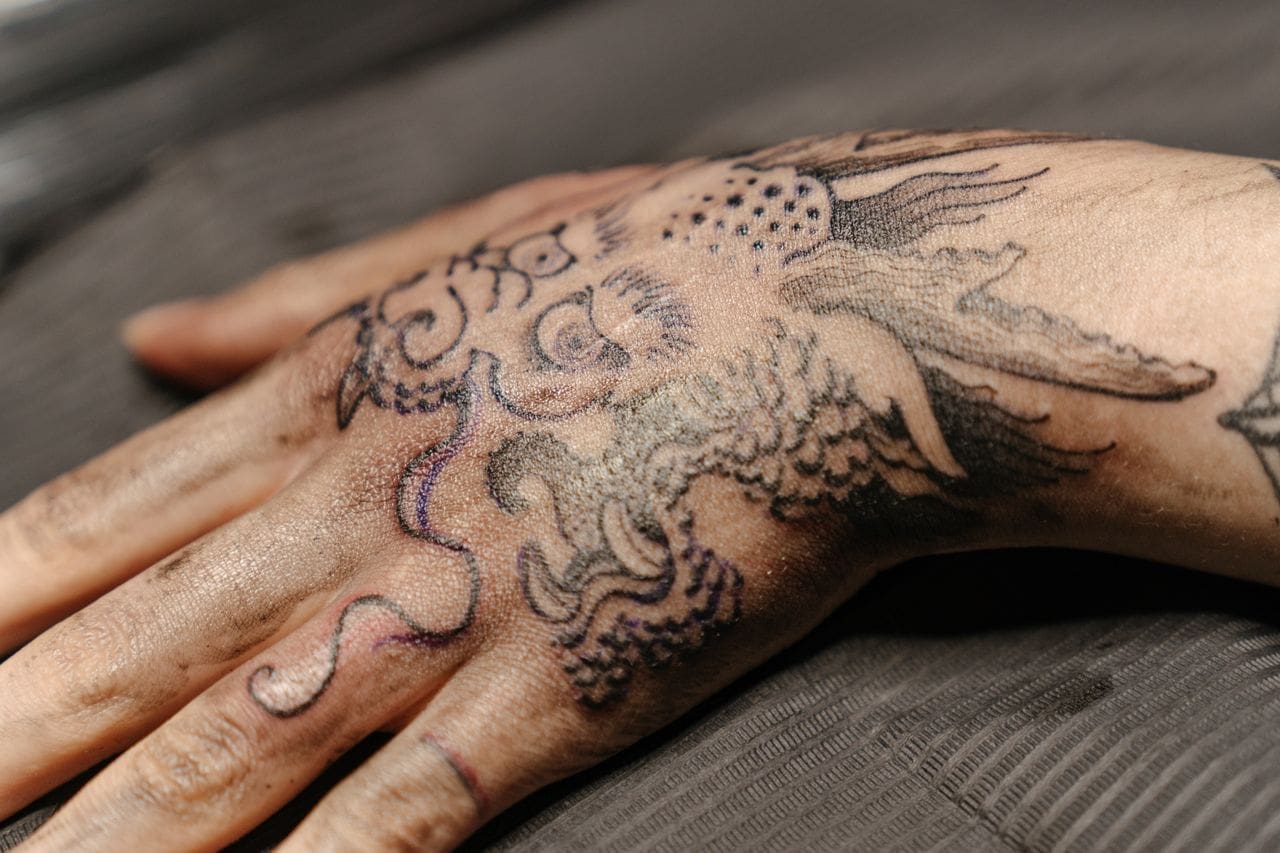
A foo dog tattoo represents protection, courage, authority, and the responsibility to guard something valuable. Despite the common English name, foo dogs are stylized guardian lions rather than domestic dogs.
These figures appear in Chinese and Japanese art under different names and visual traditions. Understanding whether a design is based on a Chinese guardian lion, Japanese shishi, or komainu helps preserve the symbolism behind its posture, pairings, and placement.
Key Takeaways
- Foo dogs are guardian lions, not ordinary dogs.
- Their central meanings include protection, courage, authority, and spiritual guardianship.
- Guardian lions traditionally appear in pairs, creating balance between complementary roles.
- Japanese komainu may use one open mouth and one closed mouth.
- A ball, cub, peony, or temple setting can change the design’s meaning.
- Placement should make the guardian appear to protect the wearer rather than move without purpose.
What Does a Foo Dog Tattoo Mean?
The central foo dog tattoo meaning is guardianship. The creature stands between a protected space and whatever may threaten it.
A tattoo may represent protecting family, personal values, spiritual beliefs, emotional boundaries, or a life rebuilt after hardship. Its snarling expression communicates that the wearer is prepared to defend what matters.
Guardian lion imagery can also represent courage and authority. The animal is not shown searching for unnecessary conflict. It remains alert, powerful, and ready to respond.
This creates a different message from a tattoo focused only on aggression. The guardian’s strength has a purpose and a boundary.
Are Foo Dogs Actually Dogs?
The term “foo dog” is widely used in English tattoo culture, but the figures are guardian lions. Museum descriptions of objects commonly called foo dogs identify them as Chinese guardian lions rather than representations of a dog breed.
Their curled manes, broad faces, compact bodies, and clawed paws can appear partly canine because the lion became highly stylized as the imagery moved through different Asian artistic traditions.
A client may still use “foo dog” when searching for tattoo references because that term is familiar to many studios. The artist should understand that the intended subject is a mythical guardian lion.
Using the more accurate term also helps when researching historical artwork. Searches for guardian lions, shishi, or komainu often produce stronger references than searches limited to foo dog tattoos.
Chinese Guardian Lions, Shishi, and Komainu
Chinese guardian lions are commonly shown protecting entrances to temples, palaces, tombs, businesses, and important buildings. Their threatening appearance is intended to discourage harmful forces and unauthorized entry.
In Japanese art, the term shishi generally refers to a lion or Chinese lion. Museum collections describe shishi as guardian lions, often with exaggerated curls, large eyes, and energetic poses.
Komainu are Japanese lion-dog guardians traditionally positioned before Shinto shrines. The Metropolitan Museum of Art describes them as paired creatures with leonine heads and canine bodies placed at shrine entrances to ward off evil.
| Term | General Context | Common Role |
| Foo dog | Popular English tattoo term | Guardian lion |
| Chinese guardian lion | Chinese architectural and religious art | Protect entrances and important spaces |
| Shishi | Japanese term for lion or Chinese lion | Guardian, auspicious animal, artistic subject |
| Komainu | Japanese shrine guardian pair | Ward off evil at Shinto entrances |
| Shisa | Okinawan guardian lion tradition | Protect homes, gates, and buildings |
These traditions are related, but they are not visually identical. A culturally informed design should establish which version is being represented before combining features.
Protection and the Guardian Role
Guardian lions are positioned at boundaries. Their traditional placement at entrances makes them symbols of protection, vigilance, and control over who or what may enter a space.
In a tattoo, the protected space becomes personal. The guardian may represent the wearer’s family, home, body, recovery, beliefs, or private emotional life.
A forward-facing lion can appear to confront an approaching threat. A lion looking over its shoulder may suggest vigilance toward past danger or protection of something positioned behind it.
The design should show what kind of guardian the creature is. An attacking pose emphasizes immediate defense, while a seated pose communicates authority and watchfulness.
Why Foo Dogs Often Appear in Pairs
Guardian lions traditionally work as a pair. Pairing creates balance and allows each figure to perform a complementary protective role.
A tattoo pair can represent two partners, parents, siblings, children, or opposing qualities within the same person. The figures may symbolize strength and compassion, action and restraint, external protection and internal stability.
The pair should be composed as connected guardians rather than two duplicated images. Differences in mouth position, paw placement, direction, or supporting objects can establish their separate roles.
A single guardian lion can still work as a tattoo. It usually represents one concentrated protective force rather than the balance created by a pair.
Open and Closed Mouth Symbolism
Japanese komainu pairs may show one figure with an open mouth and the other with a closed mouth. The Met identifies the open-mouthed figure as a-gyō and the closed-mouthed figure as un-gyō.
These expressions echo other Japanese guardian pairs, including temple protectors shown with open and closed mouths. Together, the sounds “a” and “un” can suggest completeness, from beginning to end.
In a tattoo, the open mouth may represent active warning, expression, or the release of force. The closed mouth can communicate containment, control, silence, or keeping protection within.
| Mouth Position | Visual Effect | Possible Tattoo Meaning |
| Open mouth | Loud and confrontational | Warning, active defense, expelling danger |
| Closed mouth | Controlled and watchful | Containment, discipline, preserving safety |
| Open and closed pair | Complementary guardians | Beginning and end, expression and restraint |
This mouth symbolism is most directly connected with Japanese komainu. It should not be automatically applied to every Chinese guardian lion design.
Foo Dog and Peony Tattoos
Shishi lions and peonies form a recognized pairing in Japanese art. A Metropolitan Museum of Art sword guard showing a shishi among peonies refers to the Noh play Shakkyō, which includes a famous lion dance among the flowers.
The lion contributes protection, courage, and force. The peony adds dignity, beauty, prosperity, and abundance.
Together, they can represent powerful protection surrounding something valuable. They may also show strength balanced by elegance rather than strength defined by aggression alone.
Another Japanese legend connects lions and peonies through the idea that peony dew protects the lion from parasites hidden in its fur. This relationship appears in Japanese decorative art featuring Chinese lions among peony blossoms.
The flowers should support the lion’s movement without covering its face, paws, or mane.
Common Foo Dog Tattoo Mistakes
One mistake is treating the subject as an ordinary dog. This can lead to canine anatomy that removes the lion’s mane, paws, curls, and guardian presence.
Another is mixing Chinese guardian lion details with Japanese komainu symbolism without understanding the difference. Hybrid designs are possible, but they should be intentional.
Incorrect pair placement can also weaken the concept. The lions should relate to each other and the body rather than facing random directions.
Overcrowding is another problem. Dense curls, teeth, flowers, balls, cubs, clouds, and background shading need enough space to remain readable.
The lion should look capable of guarding something. A decorative figure with no clear posture, direction, or visual authority may lose the meaning that made the subject distinctive.
Frequently Asked Questions
Can a foo dog tattoo represent a pet?
Yes. A guardian lion can be personalized with a pet’s colors, markings, name tag, or expression.
The design should still preserve the lion’s guardian features rather than becoming a realistic pet portrait.
What does a foo dog holding a jewel mean?
A jewel may represent wisdom, spiritual value, prosperity, or something precious under the guardian’s control.
Its exact meaning depends on whether the design follows a specific religious image or uses the jewel as personal symbolism.
Can a foo dog tattoo be designed as a female guardian?
Yes. Guardian lion imagery can emphasize protection, nurture, family continuity, and fierce care without changing the creature’s protective role.
A cub or family symbol can make that intention clearer.
Can foo dogs be paired with a dragon?
Yes. The guardian lions can represent stability and protection, while the dragon adds transformation, authority, clouds, or water.
The design usually needs a large placement so the creatures do not compete for space.
Designing a Guardian With a Clear Purpose
Foo dog tattoo meaning centers on protection, courage, authority, and balance. The creature is better understood as a guardian lion whose strength exists to defend a boundary, person, belief, or valued part of life.
Chinese guardian lions, Japanese shishi, and komainu share related protective roles, but their names, pair structures, and visual traditions should not be treated as identical.
Choose whether the design will use one guardian or a pair, an open or closed mouth, a ball or cub, and Chinese or Japanese visual references. A strong foo dog tattoo should make it clear not only that the guardian is powerful, but what it has been placed there to protect.