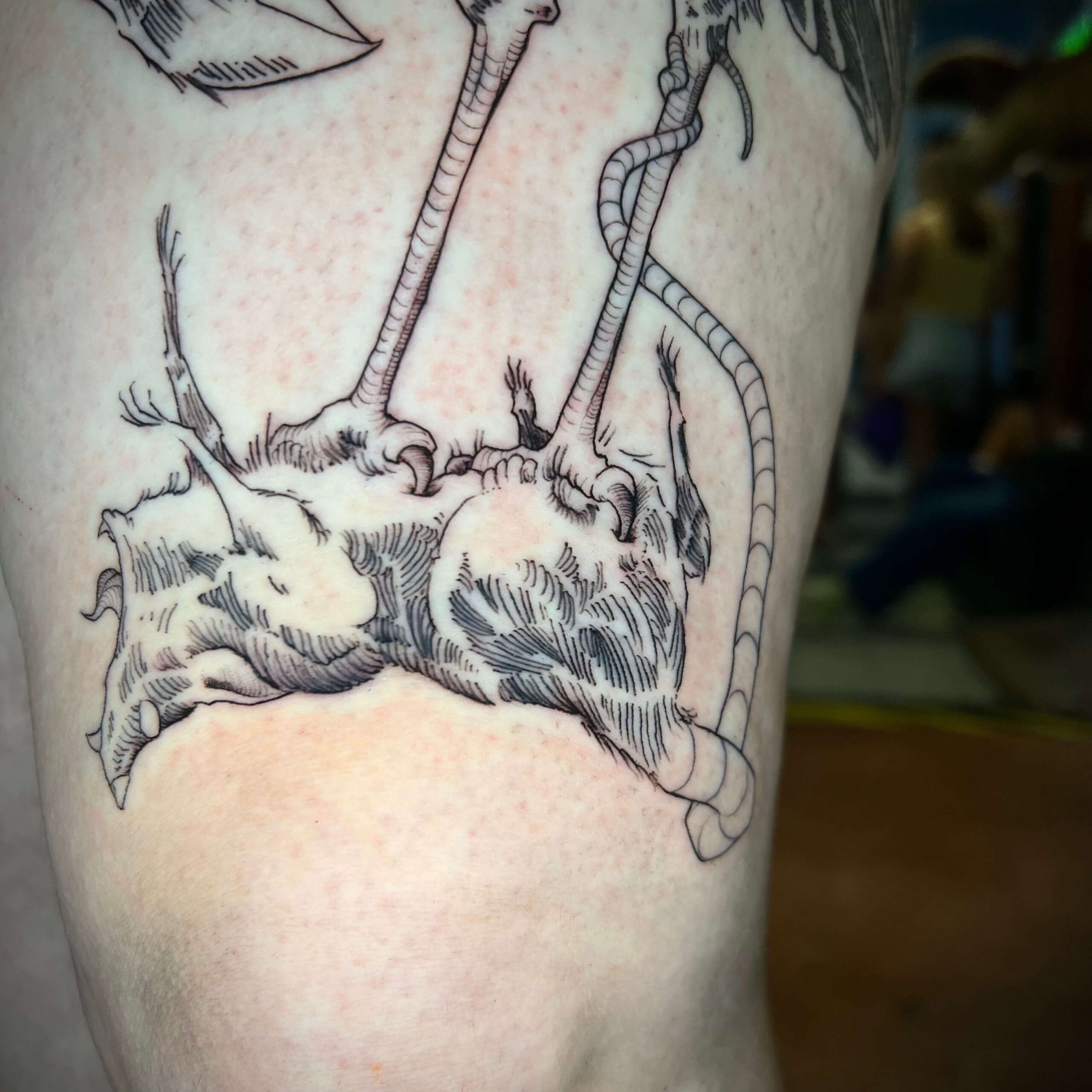
Etched tattoo design examples become more useful when they show how a concept changes across different sizes and body placements.
A botanical engraving that works on the thigh may need fewer leaves and wider spacing on the forearm. A medieval battle suited to the back may need to become a single knight or helmet when reduced to a smaller area.
This guide organizes etched tattoo ideas by scale, placement, and composition. It expands on the planning principles established in the main Etched and Woodcut-Style Tattoo Design pillar.
Key Takeaways
- Small etched tattoos work best with one clear subject.
- Medium designs can support a frame, limited background, or supporting symbol.
- Large placements can hold narrative scenes, architecture, and multiple figures.
- Vertical designs suit the forearm, calf, ribs, and spine.
- Circular designs often fit the shoulder, chest, upper arm, and thigh.
- Symmetrical compositions work well on centered placements.
- Detail should be reduced when the tattoo becomes smaller.
What Makes an Etched Tattoo Example Useful?
A useful design example shows more than an attractive subject.
It should explain how the image fits the body, how much detail the scale can support, and which parts of the composition need the strongest contrast.
The same theme can be adapted in several ways. A raven may appear as a small isolated head, a medium framed specimen, or part of a large folklore scene.
The best example is not always the most detailed option. It is the version that preserves the subject, meaning, and engraved character at the chosen size.
| Design Decision | Main Question |
| Subject | What should the viewer notice first? |
| Size | How much detail can the available space support? |
| Placement | Does the design shape fit the body area? |
| Composition | Is the image isolated, framed, circular, or narrative? |
| Contrast | Are the focal point and major shadows clear? |
| Negative space | Will important gaps remain visible? |
Small Etched Tattoo Design Examples
Small etched tattoos usually work best when they focus on one subject with a strong silhouette.
Suitable examples include a beetle, flower, skull, dagger, candle, eye, animal head, moon, anatomical heart, helmet, or small heraldic symbol.
The artist may use one clear outer contour, a few groups of parallel hatching, and one dark accent. Dense backgrounds and several layers of cross-hatching are usually unnecessary.
A small rose can use curved lines inside the petals and a dark center. A skull may use limited hatching around the temples, cheekbones, and eye sockets.
A moth can retain its symmetry with simplified wing patterns. A dagger can use straight hatching along the blade and a small black section in the handle.
Small Botanical Example
A single flower with two or three leaves can fit the inner forearm, upper arm, calf, or thigh.
The stem should remain clear, and the petals should not contain more linework than the size can support.
Roots, labels, insects, and background ornament may be removed when the design becomes compact.
Small Animal Example
An animal head works better than a full body when the available area is limited.
A wolf, raven, stag, snake, or cat can be reduced to its most recognizable features. Strong eyes, ears, beak, horns, or facial shape protect the silhouette.
Small Symbolic Example
A candle, eye, moon, key, hourglass, or sacred heart can carry clear meaning without a complete scene.
One or two supporting details may be added, but the symbol should remain dominant.
| Small Design | Suitable Placement | Main Simplification |
| Beetle specimen | Forearm or upper arm | Reduce wing texture |
| Flower | Wrist, forearm, or calf | Limit leaves and hatching |
| Skull | Upper arm or thigh | Simplify teeth and cracks |
| Dagger | Forearm or calf | Use clean blade lines |
| Animal head | Upper arm or calf | Remove background imagery |
| Anatomical heart | Forearm or chest | Reduce vessels and labels |
Medium Etched Tattoo Design Examples
Medium tattoos provide room for one central subject with a frame, secondary object, or controlled background.
These designs work well on the forearm, calf, upper arm, shoulder blade, ribs, and thigh.
A medium raven may include the full body, a branch, and a circular moon. An anatomical heart can be framed with flowers, thorns, or a short banner.
A knight can appear beneath an arch with a sword and shield. The background may include one tower or section of ruined architecture rather than a complete battlefield.
Medium designs should still have one clear focal point. Supporting elements can establish context without receiving the same level of detail.
Medium Framed Botanical Example
A flower, root system, and insect can be placed inside an ornamental frame.
The frame should remain lighter or simpler than the botanical subject. Dense filigree can compete with leaves and petals.
This type of design suits the forearm, calf, upper arm, or thigh.
Medium Anatomical Example
An anatomical heart combined with one flower or celestial symbol creates a focused composition.
The heart should carry the darkest hatching, while the supporting object uses lighter texture.
A banner or short date may be included when the lettering remains large enough to read.
Medium Medieval Example
A single knight beneath a ruined arch can create a complete historical scene without requiring several figures.
The armor, weapon, and silhouette should receive the strongest contrast. The architecture can remain secondary.
| Medium Design | Best Composition | Suitable Placement |
| Raven and moon | Circular or framed | Upper arm or thigh |
| Heart and flower | Framed | Forearm or chest |
| Knight beneath arch | Vertical | Calf or thigh |
| Ship and waves | Vertical | Forearm or calf |
| Saint portrait | Framed | Upper arm or thigh |
| Snake and botanicals | Body-wrapping | Forearm or calf |
Large Etched Tattoo Design Examples
Large tattoos can support several figures, architecture, landscapes, and layered symbolism.
The thigh, chest, back, side, and full sleeve provide enough space for narrative compositions.
A large design still needs visual hierarchy. More space should not result in equal detail across every section.
The central figure should carry the strongest contours and contrast. Background buildings, clouds, waves, trees, or supporting figures can use lighter linework.
Large Medieval Battle Example
A back or thigh piece may show a knight confronting a dragon outside a ruined castle.
The knight and dragon should remain distinct, with open space between weapons, wings, and architecture.
Clouds, banners, and distant figures can establish atmosphere without becoming separate focal points.
Large Maritime Example
A ship in a storm can include waves, rigging, clouds, a sea creature, and celestial navigation symbols.
The ship should remain the main silhouette. Dense water and cloud textures should not hide the sails or hull.
The thigh, back, chest, or side can support this type of composition.
Large Religious Example
A saint or angel may be framed by cathedral arches, rays, flowers, and sacred symbols.
The face should receive the cleanest treatment, while robes, wings, and architecture build outward from the focal point.
Centered chest, upper-back, and full-back placements suit formal religious compositions.
Large Botanical and Anatomical Example
A sleeve can combine roots, bones, flowers, insects, organs, and celestial elements.
The design may move from darker roots or skeletal imagery near the lower arm toward lighter flowers and open forms higher on the body.
The transitions should follow one visual direction rather than resemble separate stickers placed beside one another.
Vertical Composition Examples
Vertical compositions follow the length of a body area.
Suitable subjects include flowers, ships, towers, swords, snakes, standing figures, skeletal forms, and root systems.
The forearm and calf are common choices because they provide a long viewing area with limited width.
A cathedral can rise from dark foundations toward lighter towers. A botanical design can move from roots at the bottom toward flowers at the top.
The design should follow the natural line of the limb rather than remain perfectly straight when the body curves.
Frequently Asked Questions
Can the same etched design work on both an arm and a leg?
The subject may work on both, but the composition usually needs adjustment for the width, curvature, and viewing angle of each placement.
Can two small etched tattoos be arranged as one composition?
Yes. Matching frames, repeated textures, shared symbolism, or connecting elements can make separate tattoos feel related.
Does an etched tattoo need a visible border?
No. A border can create a printed-page appearance, but isolated and body-wrapping designs may work better without one.
Can an asymmetrical design still feel balanced?
Yes. Visual balance can come from the distribution of black, detail, open skin, and subject size rather than mirrored shapes.
Choose the Example That Fits the Available Space
Etched tattoo examples should be evaluated by more than subject matter.
A successful concept matches its detail to the size, uses a composition suited to the placement, and keeps the main silhouette clear.
Small tattoos benefit from isolated subjects. Medium designs can include framing or one supporting element, while large placements can hold narrative scenes and layered symbolism.
Use design examples to identify your preferred direction, then allow the artist to rebuild the concept for your body rather than copying a composition designed for someone else.