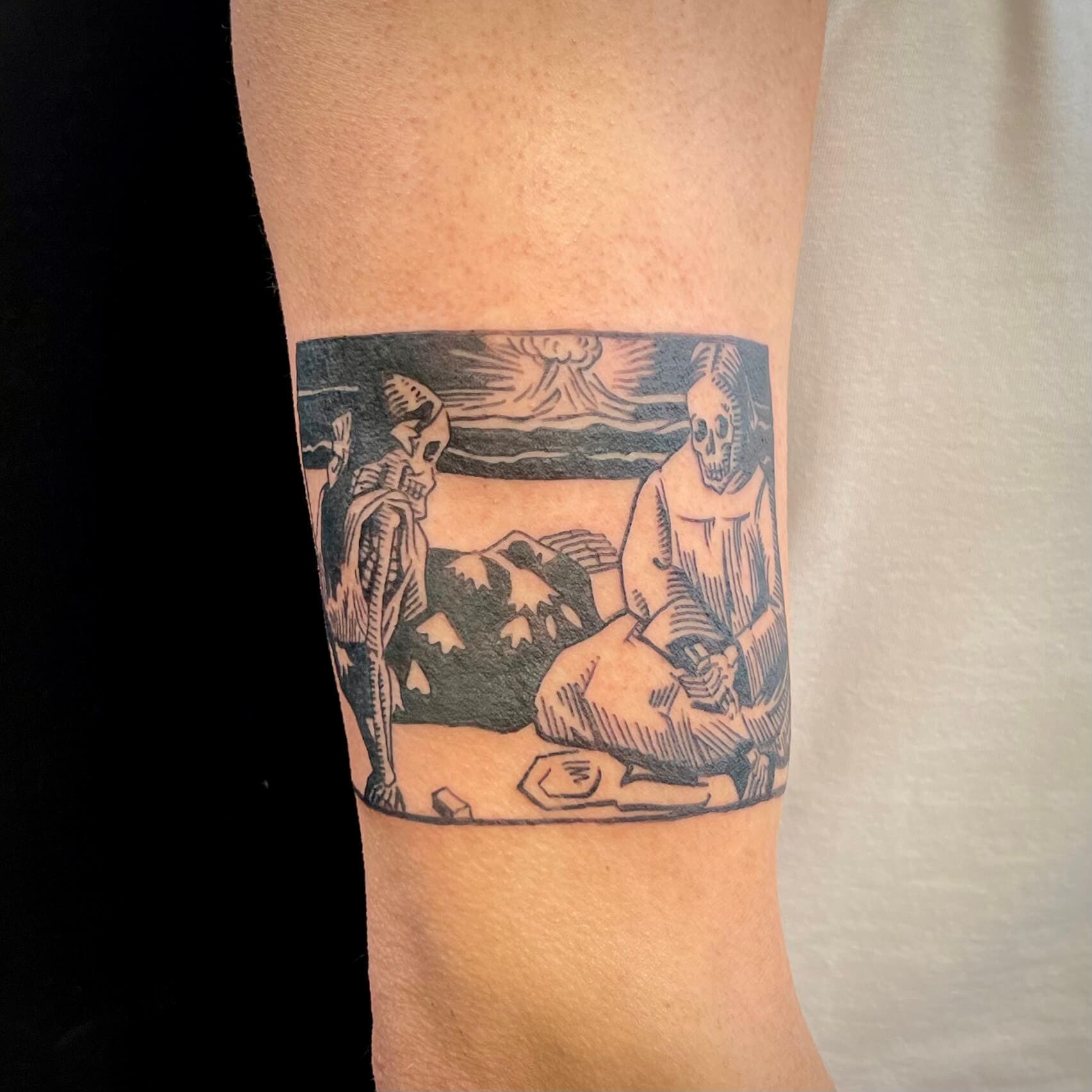
Etched style tattoos draw from the appearance of historical printmaking, where images were built through carved or incised lines rather than smooth painted shading. On skin, the style uses contour lines, hatching, cross-hatching, stippling, solid black, and negative space to create an antique illustrated effect.
The meaning of an etched tattoo does not come from the technique alone. It develops through the relationship between the chosen subject, historical influence, line treatment, composition, and the wearer’s personal interpretation.
A skull rendered with engraved lines may represent mortality, while a botanical specimen can suggest growth, healing, poison, or memory. The same etched texture can support very different meanings depending on the imagery surrounding it.
Key Takeaways
- Etched style refers to the visual construction of the tattoo, not one fixed meaning.
- Historical printmaking gives the style an antique, documented, or archival quality.
- Subject matter determines most of the tattoo’s symbolism.
- Fine hatching often creates a refined or analytical tone.
- Rougher carved marks can make the design feel severe, ancient, or folkloric.
- Botanical, anatomical, religious, occult, and memento mori imagery are common choices.
- Personal meaning should guide the symbols rather than decorative appearance alone.
What Does an Etched Style Tattoo Mean?
An etched style tattoo usually suggests a connection to history, illustration, craftsmanship, or old-world visual culture. Its linework can make the subject appear as though it came from a manuscript, scientific plate, religious print, or engraved book.
The technique often gives familiar imagery a more serious or timeless character. A simple animal portrait may feel like a natural-history study, while a flower may resemble a preserved specimen from an old botanical reference.
Etched tattoos can also communicate permanence through their visual association with carved surfaces. The design may appear cut, recorded, or preserved rather than casually drawn.
This does not mean every etched tattoo carries a historical message. A modern object, portrait, or personal symbol can use etched shading while keeping a completely contemporary meaning.
Why Historical Printmaking Changes the Mood
Traditional etching and engraving relied on individual lines to create depth, shadow, texture, and form. This visible mark-making gives the finished image a different emotional quality from smooth realism or minimal linework.
Fine, controlled lines can make the tattoo feel careful, intellectual, or observational. This is why etched techniques suit anatomical studies, maps, architecture, plants, and scientific subjects.
Dense cross-hatching and dark black areas can create a more dramatic mood. These qualities often appear in tattoos involving death, conflict, religion, folklore, or supernatural imagery.
Rougher woodcut-inspired marks can make a design feel older and more severe. They work well when the subject calls for danger, struggle, ritual, or medieval atmosphere.
| Visual Treatment | Common Impression |
| Fine curved hatching | Refined, detailed, analytical |
| Dense cross-hatching | Dramatic, shadowed, serious |
| Heavy carved lines | Ancient, severe, folkloric |
| Stippling | Atmospheric, mysterious, gradual |
| Solid black | Powerful, grounded, confrontational |
| Open negative space | Clear, restrained, symbolic |
Meaning Through Botanical Imagery
Botanical etched tattoos often resemble herbals, scientific plant studies, or natural-history illustrations.
Flowers may represent beauty, love, remembrance, grief, or change. Roots can suggest ancestry, stability, hidden growth, or attachment to a place.
Poisonous plants introduce a different meaning. They can symbolize danger, secrecy, protection, transformation, or the contrast between beauty and harm.
A complete plant shown from flower to root may suggest that visible growth depends on unseen foundations. This format works especially well when the wearer wants the tattoo to represent development, family history, or personal resilience.
Botanical symbolism should be chosen carefully because plants can carry different meanings across cultures and personal experiences.
Animal Symbolism in Etched Tattoos
Animals work well in etched designs because fur, feathers, scales, horns, and anatomy can be described through directional linework.
Ravens may suggest memory, intelligence, prophecy, death, or transformation. Wolves can represent instinct, loyalty, danger, independence, or protection.
Insects create a more specimen-like effect. Moths may suggest transformation, attraction, fragility, or movement toward light, while beetles can represent endurance, protection, or renewal.
The pose also changes the meaning. A profile animal can feel observational and scientific, while a front-facing animal may appear more confrontational, protective, or heraldic.
Anatomical Imagery and the Meaning of the Body
Anatomical etched tattoos often explore life, mortality, vulnerability, and physical structure.
An anatomical heart can represent emotion, devotion, grief, life, or the tension between feeling and biology. Flowers, flames, thorns, or roots can shift its meaning toward love, sacrifice, pain, or growth.
Skeletal hands may suggest death, time, memory, or the temporary nature of physical life. A hand holding a candle can connect mortality with guidance, hope, or remembrance.
Skulls are common in etched tattooing because their structure suits cross-hatching and strong black shadows. Their meaning may involve death, acceptance, transformation, remembrance, or fearlessness.
Anatomical imagery does not always need to feel dark. It can also express curiosity, medical interest, personal survival, or respect for the complexity of the body.
Memento Mori and Vanitas Meaning
Memento mori imagery reminds the viewer that life is temporary.
Skulls, candles, hourglasses, bones, and dying flowers are common symbols. They may encourage reflection, acceptance, humility, or appreciation for limited time.
Vanitas designs expand this idea by including wealth, beauty, status, knowledge, and pleasure. Coins, mirrors, books, fruit, flowers, jewelry, and crowns may appear beside signs of decay.
The message is not always pessimistic. These tattoos can encourage the wearer to value meaningful experiences instead of temporary possessions or appearances.
| Symbol | Common Interpretation |
| Skull | Mortality, acceptance, remembrance |
| Hourglass | Passing time, limited opportunity |
| Candle | Life, guidance, eventual ending |
| Wilted flower | Fading beauty, grief, transition |
| Mirror | Identity, appearance, self-reflection |
| Crown | Temporary power or status |
| Book | Knowledge, memory, unfinished learning |
Religious and Sacred Interpretation
Etched techniques have a natural connection to historical religious prints and devotional art.
Saints, angels, crosses, sacred hearts, halos, and relics may represent faith, sacrifice, protection, devotion, forgiveness, or spiritual identity.
A halo can establish holiness or focused spiritual importance. Thorns may suggest suffering, while lilies can represent purity, mourning, or renewal.
Religious imagery should be researched before it becomes part of a tattoo. A symbol may carry a specific theological or cultural meaning beyond its visual appeal.
The wearer should also decide whether the design is devotional, memorial, historical, or artistic. That intention can influence the pose, framing, supporting symbols, and placement.
Occult and Alchemical Symbolism
Occult and alchemical imagery often suits the structured appearance of etched diagrams.
Eyes, moons, planetary symbols, serpents, ritual hands, seals, and geometric systems may represent hidden knowledge, transformation, observation, fate, or spiritual exploration.
Alchemy is frequently associated with change and the movement from one state to another. A design may use vessels, suns, moons, metals, or symbolic creatures to represent a personal transformation.
Circular compositions can suggest cycles, balance, protection, repetition, or eternity. A serpent forming a ring may represent renewal, self-containment, or continuing change.
These symbols should not be combined randomly. Some have specific religious, philosophical, ceremonial, or political associations.
Turning Personal Meaning Into a Clear Design
Begin with the message rather than a collection of attractive symbols.
Choose one primary subject that communicates the main idea. Supporting objects should add context rather than introduce unrelated meanings.
A memorial design might use one flower, a candle, and a date. A transformation tattoo might combine a snake, roots, and a celestial cycle.
The composition also matters. Symmetrical designs can feel formal or ritualistic, while vertical designs may suggest growth, ascent, or progression.
Bring the intended symbolism to the artist during the consultation. This helps the artist simplify the reference without removing the elements that matter most.
Frequently Asked Questions
Can an etched tattoo represent a modern idea?
Yes. Technology, urban imagery, portraits, machines, and personal objects can be drawn with historical etched linework while keeping a modern meaning.
Does a distressed etched texture always symbolize age or decay?
No. Distressed texture may simply create a handmade print effect, although it can also support themes involving history, damage, memory, or impermanence.
Can two people use the same etched symbol with different meanings?
Yes. Personal history, supporting imagery, placement, and composition can change how the same symbol is interpreted.
Should an etched tattoo include text to explain its meaning?
Not necessarily. A strong visual composition can communicate the main idea without lettering, although a short date, label, name, or phrase may add personal context.
Choose Meaning Before Adding Detail
Etched style tattoos can represent history, memory, mortality, faith, knowledge, transformation, nature, or personal identity.
Their meaning comes primarily from the subject and the relationship between the supporting symbols. The etched technique adds an antique, preserved, or handcrafted tone to that message.
Start with one clear idea, then choose imagery that reinforces it. A focused design usually carries more meaning than a crowded arrangement of unrelated historical symbols.
The artist can then adapt the concept into a tattoo with suitable scale, line spacing, contrast, and negative space while preserving the symbolism that matters most.