
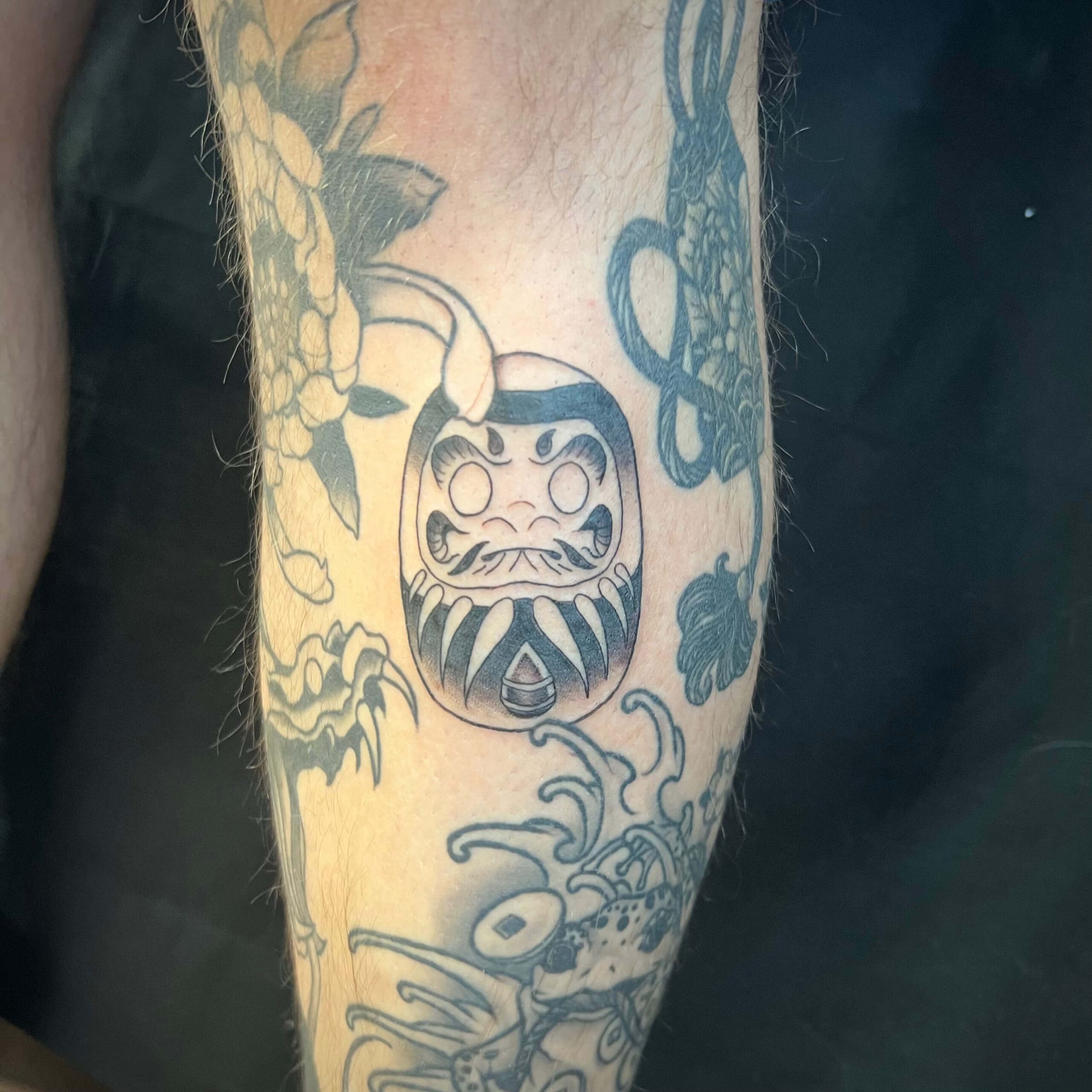
Japanese tattoo background elements do more than fill empty skin around a dragon, koi fish, mask, or warrior.
Clouds, wind bars, waves, and rocks establish the setting, guide the eye, separate subjects, and connect different parts of the tattoo into one composition. Their direction and visual weight should support the main subject rather than compete with it.
Key Takeaways
- Japanese tattoo backgrounds create movement, atmosphere, framing, and visual continuity.
- Waves suit water-based subjects, while clouds support aerial, spiritual, and mythological imagery.
- Wind bars show direction and help separate different parts of a composition.
- Rocks provide stability and contrast against flowing water, wind, and clouds.
- Background elements should follow the same directional path as the focal subject.
- Negative space keeps dense background work readable over time.
Why Background Elements Matter in Japanese Tattooing
Japanese-style tattooing is usually designed as a connected scene rather than a collection of isolated images.
The background explains where the main subject exists and how it moves through the composition. A koi needs water, a dragon may travel through clouds and storms, and a tiger may stand among rocks, bamboo, and wind.
Background work also helps the tattoo fit the body.
Curved waves can wrap around a forearm, clouds can move across the shoulder, and wind bars can connect imagery between the chest and upper arm.
| Background Element | Primary Function | Common Pairings |
| Waves | Movement, adversity, natural force | Koi, dragons, lotus flowers |
| Clouds | Atmosphere, elevation, transition | Dragons, cranes, deities |
| Wind bars | Direction, separation, visual flow | Flowers, masks, birds |
| Rocks | Stability, grounding, environmental structure | Tigers, water, plants |
| Lightning | Intensity and sudden change | Dragons, Oni, storm scenes |
| Mist or foam | Transition and negative space | Water, clouds, landscapes |
Waves Create Movement and Natural Power
Waves are among the most recognizable Japanese tattoo background elements.
They can represent movement, adversity, change, strength, and the unpredictable force of nature.
The intensity of the water affects the mood.
Gentle currents may communicate balance, patience, or steady progress, while breaking waves can suggest resistance, danger, emotional pressure, or active struggle.
Waves also create a clear environment for koi fish, lotus flowers, dragons, boats, and water-based narratives.
The water should move with the central subject. A koi swimming upward should not be surrounded by currents that create an unrelated downward path unless the conflict is intentional.
Foam and Open Skin
Foam helps separate dark water from the main subject.
Artists may use open skin, pale pigment, or simplified curved shapes to show the crest and spray of a wave.
These lighter areas keep the background from becoming one heavy block of ink.
They can also protect the outline of a dark koi, dragon, rock, or flower.
Wave Scale and Repetition
Large wave shapes create bold movement across sleeves, legs, and back pieces.
Smaller foam details add texture, but they should not become so dense that the water loses its readable structure.
Repeated curls create rhythm.
The artist should vary their size and spacing so the background feels responsive to the scene instead of mechanically patterned.
Clouds Establish Atmosphere and Elevation
Clouds are commonly used around dragons, cranes, phoenixes, deities, warriors, and supernatural figures.
They can represent atmosphere, spirituality, transition, distance, and the space between earthly and elevated scenes.
Clouds also provide useful framing.
A cloud field can separate a dragon’s head from its body, create open space around a face, or connect the upper section of a sleeve to a chest panel.
Soft Clouds Versus Storm Clouds
Soft cloud shapes create a calm or elevated mood.
They work well with cranes, phoenixes, sacred imagery, or dragons presented as wise and protective.
Dark storm clouds create greater tension.
They may be combined with lightning, wind, or rain to support Oni, dragons, battle scenes, and other intense narratives.
| Cloud Treatment | Visual Mood | Suitable Subjects |
| Open, rounded clouds | Calm, spiritual, elevated | Cranes, phoenixes, deities |
| Dark cloud fields | Dramatic, heavy, threatening | Oni, dragons, warriors |
| Clouds with lightning | Sudden power and conflict | Storm dragons, supernatural figures |
| Clouds fading into mist | Transition and depth | Sleeves, back pieces, landscapes |
Wind Bars Control Direction and Separation
Wind bars are curved bands that create movement through a Japanese tattoo composition.
They may pass behind flowers, masks, birds, warriors, and other subjects to show that the entire scene shares one directional force.
Wind bars also divide visual areas.
They can separate a flower section from a mask, create space between two characters, or transition from a chest panel into a sleeve.
Their curves should relate to the body.
On an arm, wind bars may spiral around the limb. On a back piece, they can move diagonally or horizontally to support a larger narrative.
Wind Bars and Flower Movement
Cherry blossoms, maple leaves, and loose petals often follow the direction established by wind bars.
This creates visual evidence that the background and supporting motifs belong to the same environment.
Flowers moving in one direction while the wind bars curve another way can make the tattoo feel disconnected.
The artist should decide where the wind begins, where it travels, and how it exits the composition.
Rocks Add Stability and Grounding
Rocks provide a solid visual base beneath tigers, Foo Dogs, warriors, flowers, and water-based subjects.
They represent endurance, stability, resistance, and connection to the physical environment.
Rocks create contrast against moving elements.
Water flows around them, wind passes over them, and flowers grow beside them.
This contrast can strengthen a story about persistence.
The rock remains stable while the surrounding environment changes.
Using Rocks to Organize the Composition
Dark rock shapes can divide sections of water, support a standing figure, or create a visual boundary near the lower edge of a tattoo.
They can also provide strong black areas that balance bright flowers or open skin elsewhere.
The artist should avoid treating rocks as random black filler.
Their shape, angle, and placement should support the main direction of the composition.
How Background Elements Work Together
Large Japanese tattoos often use more than one background system.
A dragon may rise from waves into mist and clouds. A tiger may stand on rocks while wind moves through bamboo and maple leaves.
The transition between elements should feel gradual.
Foam can soften into mist, mist can lead into clouds, and curved cloud forms can connect with wind bars.
| Transition | How It Works |
| Waves to mist | Foam and spray become lighter and less defined |
| Mist to clouds | Soft transitional shapes create elevation |
| Clouds to wind bars | Repeated curves establish directional movement |
| Rocks to water | Waves wrap around or break against solid forms |
| Wind to flowers | Petals and leaves follow the same directional path |
Mikiri and Gakubori in Background Planning
Mikiri refers to the framing and transition between the tattooed composition and open skin.
It gives sleeves, chest panels, back pieces, and bodysuits a controlled outer boundary.
Waves, clouds, and wind bars may form this edge.
The framing should feel intentional rather than ending in random background fragments.
Gakubori refers to the decorative background work that surrounds and connects the main subjects.
It may include water, wind, clouds, rocks, foam, mist, or other natural forms.
The purpose of Gakubori is continuity.
It should make separate motifs feel like parts of the same environment without hiding the focal image.
Negative Space Keeps Backgrounds Readable
Japanese backgrounds can contain bold outlines, dark shading, repeated curves, foam, clouds, rocks, and flowers.
Without enough open skin, these elements may merge into a dense field.
Negative space creates separation around faces, claws, fins, flower petals, and other important details.
It can also form highlights in water and clouds.
Open skin should be planned as part of the design.
Random gaps may make a composition appear unfinished, while controlled skin breaks strengthen contrast and hierarchy.
Frequently Asked Questions About Japanese Tattoo Backgrounds
Can Japanese background work be added years after the main tattoo?
It may be possible, but the artist must work with the existing spacing, contrast, and direction.
Older ink may also need minor adjustments so the completed background looks visually consistent.
Do all Japanese-style tattoos need wind bars?
No. Wind bars are one background option rather than a requirement.
Can clouds and waves be used around an existing non-Japanese tattoo?
Sometimes, but the difference in line work, shading, and visual style may remain noticeable.
The artist should explain whether the existing piece can be integrated or only framed.
Should Japanese tattoo backgrounds stop at the wrist or ankle?
The stopping point depends on concealment preferences, placement, and the intended outer framing.
Strong Backgrounds Turn Separate Images Into One Composition
Clouds, wind bars, waves, and rocks give Japanese tattoos structure, movement, and a believable environment.
Each element should have a clear purpose. Waves create motion, clouds establish atmosphere, wind bars control direction, and rocks add stability.
The strongest background supports the focal subject without taking over the design.
Plan its direction, contrast, transitions, and outer framing before tattooing begins so every section feels connected to the same visual story.