
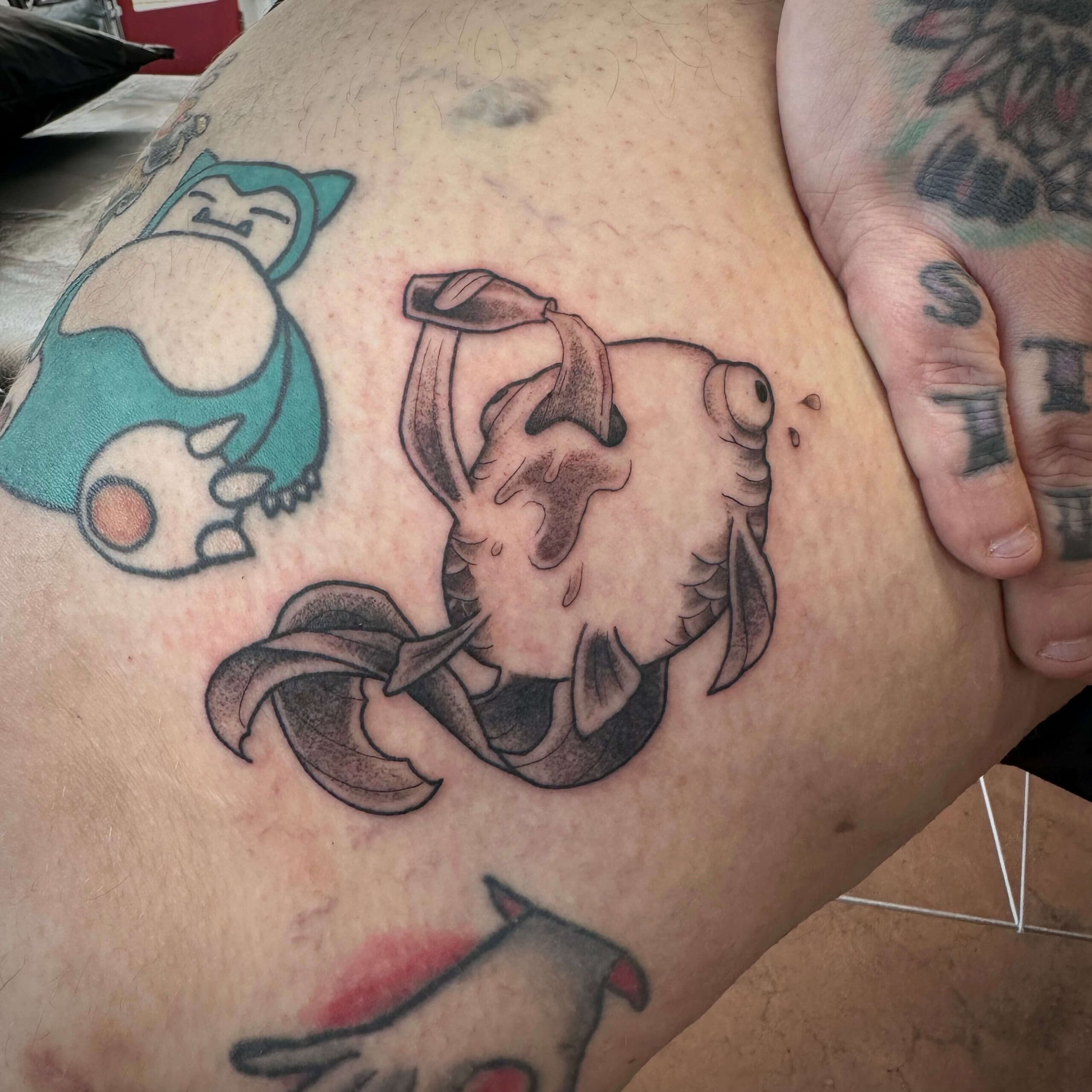
Koi fish tattoos are commonly associated with perseverance, courage, transformation, and the ability to continue through difficult conditions.
Their meaning can change through color, swimming direction, water movement, flowers, and surrounding imagery. A strong koi design combines these details into one clear story rather than relying on the fish alone.
Key Takeaways
- Koi fish commonly represent perseverance, courage, progress, and transformation.
- Swimming direction can suggest struggle, progress, return, or completed growth.
- Color may add personal or symbolic meaning, but interpretations are not universal.
- The koi’s size, posture, and placement affect how the tattoo moves across the body.
- One clear narrative usually creates a stronger design than several unrelated symbols.
What Does a Koi Fish Tattoo Mean?
The koi fish is valued for its strength, determination, and ability to move through changing water.
In tattoo design, it often represents someone continuing through hardship, working toward a goal, or changing through experience.
Koi symbolism is also connected with courage and personal development.
A calm koi moving through gentle water may communicate steady progress, while a fish pushing through large waves may place more emphasis on struggle and resistance.
The meaning becomes more specific when the artist adds color, direction, flowers, weather, or another central subject.
| Koi Design Feature | Possible Emphasis |
| Strong upward movement | Determination and progress |
| Calm swimming posture | Balance and steady growth |
| Rough waves | Adversity and resistance |
| Clear water | Direction and emotional clarity |
| Paired koi | Partnership, balance, or shared progress |
| Changing environment | Transformation and transition |
Why Water Matters in Koi Tattoo Symbolism
Koi and water should usually be planned together because the environment explains what the fish is experiencing.
The water may appear calm, fast, turbulent, deep, or interrupted by rocks.
A koi moving through rough waves can represent persistence under pressure.
A fish surrounded by gentle currents may suggest patience, stability, or controlled movement rather than active struggle.
Water direction also affects the composition.
Currents, foam, and wave curves should guide the eye along the same path as the fish instead of creating conflicting movement.
Upward-Swimming Koi Meaning
An upward-swimming koi is often interpreted as moving toward a challenge, goal, or transformation.
The direction can suggest that the struggle is still active and that the wearer is continuing forward despite resistance.
This interpretation works especially well when the fish appears to push against waves or rising water.
The pose should still feel natural across the chosen body area.
On a sleeve, an upward koi may move from the forearm toward the shoulder. On a leg, it may rise from the calf toward the thigh.
Downward-Swimming Koi Meaning
A downward-swimming koi is sometimes associated with returning after a challenge, moving with the current, or reaching a stage of acceptance.
It does not automatically mean failure or surrender.
The surrounding water and posture help explain whether the fish appears calm, powerful, exhausted, or in control.
A downward koi may also create better anatomical flow in certain placements.
The artist should balance symbolic preference with the direction that best fits the arm, leg, chest, or back.
| Swimming Direction | Common Interpretation | Design Consideration |
| Upward | Progress, effort, active struggle | Works well with rising waves |
| Downward | Return, acceptance, completed challenge | Can follow natural downward anatomy |
| Horizontal | Stability, movement through life | Suits longer placements |
| Curved around the body | Adaptability and continuous motion | Effective for sleeves and legs |
Koi Fish Tattoo Meaning by Color
Color can add another layer of meaning, but there is no single universal code that every artist or wearer must follow.
Some people choose koi colors for traditional associations, while others select them for personal memories, visual balance, or contrast with surrounding elements.
Black Koi
A black koi is commonly connected with overcoming hardship, survival, strength, and major personal change.
The dark body can create strong contrast against pale water, open skin, red flowers, or grey backgrounds.
Black koi also work well in black and grey compositions where the artist needs a clear focal silhouette.
Red Koi
Red koi may represent strength, courage, intense emotion, love, or determination.
The meaning depends on whether the design feels calm, aggressive, romantic, or protective.
Red creates a strong focal point and should be balanced carefully with flowers, water, and black background areas.
Blue Koi
Blue koi are often associated with calmness, control, loyalty, or masculine energy.
They may also be selected simply because blue works naturally within a water-based composition.
A blue fish needs enough contrast from the surrounding water so its body does not disappear into the background.
Gold or Yellow Koi
Gold and yellow koi may suggest prosperity, achievement, success, or abundance.
These colors can create a bright focal point against dark waves, rocks, or black shading.
Gold effects should be simplified into tattoo-friendly color fields rather than designed like reflective metal.
White Koi
White koi may suggest purity, renewal, peace, or a fresh beginning.
White pigment can behave differently across skin tones and may change as it heals, so artists often use open skin or light tones to create the effect.
Multicolored Koi
A multicolored koi can represent a more personal story that does not depend on one symbolic interpretation.
The artist should keep the palette controlled so the fish remains connected to the rest of the composition.
| Koi Color | Common Associations | Design Strength |
| Black | Survival, hardship, transformation | Strong silhouette and contrast |
| Red | Courage, emotion, determination | Powerful focal color |
| Blue | Calmness, control, loyalty | Natural connection with water |
| Gold or yellow | Success, prosperity, achievement | Bright contrast against dark backgrounds |
| White | Renewal, purity, peace | Light and open appearance |
| Multicolored | Personal meaning and individuality | Flexible visual storytelling |
The Dragon Gate Legend and Koi Transformation
The Dragon Gate legend explains why koi are strongly associated with perseverance, achievement, and transformation.
In the story, carp gather below difficult rapids known as the Dragon Gate on China’s Yellow River. A carp that succeeds in climbing the falls transforms into a dragon, turning the journey into a symbol of hard work leading to success.
Japanese art adopted the ascending carp as an image of courage and accomplishment. Hokusai and other print artists depicted carp climbing waterfalls, helping establish the visual connection between resistance, progress, and eventual transformation.
In tattoo design, the legend can support a koi moving upward through rough water, while a dragon may represent the power or wisdom reached after the struggle.
A koi-to-dragon composition works best on a sleeve, back piece, or leg sleeve where the artist has enough space to show both stages without crowding the water, clouds, and supporting motifs.
Koi Fish in Traditional Japanese Tattooing
Within traditional Japanese tattooing, koi are usually treated as major compositional subjects rather than small decorative fish.
Their long bodies, fins, scales, and swimming movement work naturally with the anatomical flow of sleeves, leg pieces, chest panels, and back pieces. Waves, rocks, lotus flowers, and seasonal plants establish the environment and connect the koi to the surrounding body area.
Traditional Irezumi composition also considers hierarchy, season, background framing, and negative space.
The koi should remain readable as the focal subject, while water and botanical elements reinforce its movement and symbolism without overwhelming its silhouette.
An upward koi is often connected with active perseverance, while the larger composition determines whether the story emphasizes hardship, courage, growth, family, or transformation. Direction should still be chosen according to body flow rather than treated as a rigid symbolic rule.
Frequently Asked Questions About Koi Fish Tattoos
Can a koi tattoo include realistic water instead of traditional waves?
Yes. Realistic water can work with a koi, but it will move the design toward realism or Neo-Japanese tattooing.
The fish and background should use compatible shading, detail, and lighting.
Do the number of koi in a tattoo have a fixed meaning?
No universal meaning applies to every number of koi.
The number may represent family members, personal milestones, relationships, or compositional balance.
Can a koi fish tattoo be designed as a cover-up?
Koi designs can work for some cover-ups because scales, dark color, waves, rocks, and background shading provide coverage options.
Should a koi tattoo face toward or away from the center of the body?
There is no absolute rule.
The artist should consider body flow, the position of other subjects, and where the fish directs the viewer’s attention.
Build the Koi’s Meaning Through the Entire Design
Koi fish tattoo symbolism comes from more than the fish’s color or swimming direction.
Water movement, flowers, season, placement, posture, and supporting imagery determine whether the design emphasizes struggle, transformation, balance, achievement, or renewal.
Choose the central meaning first, then select the direction and color that support it.
A well-planned koi tattoo will feel like one complete story rather than a fish surrounded by unrelated decorative elements.